Forex Trading in Nigeria: Everything You Need to Know in 2026
Forex trading in Nigeria is booming — with over 200,000 active traders and growing. Discover the regulatory landscape, top currency pairs, local payment methods, and how to choose the right broker in 2026.
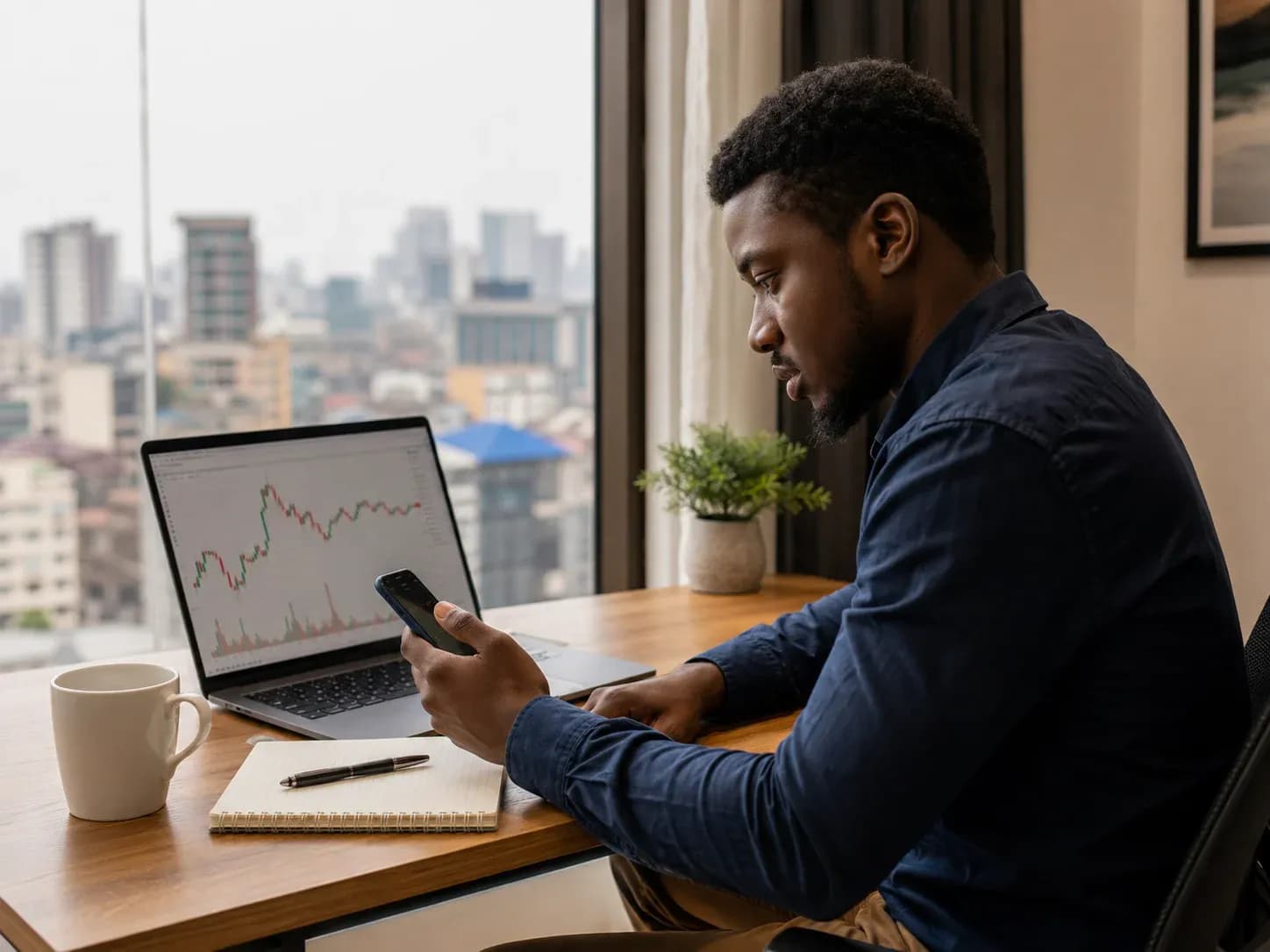
Why Forex Trading in Nigeria Is Bigger Than Ever in 2026
Forex trading in Nigeria has moved well past the fringes. What was once a niche activity discussed in small online forums is now a mainstream financial pursuit, referenced in university WhatsApp groups, Lagos co-working spaces, and Abuja investment circles alike. The market has matured, the infrastructure has improved, and Nigerian traders are increasingly sophisticated about what they want from a broker. If you're still building the foundations of what is forex trading, our beginner's guide covers those before you get into Nigeria's specifics.
The Rise of Retail Forex Trading Across Nigeria
A decade ago, accessing global currency markets from Nigeria required navigating unreliable payment systems, expensive wire transfers, and brokers who had little interest in African clients. That picture has changed significantly. Faster internet penetration (Nigeria's active internet users crossed 100 million in 2023, according to the Nigerian Communications Commission), widespread smartphone adoption, and the entry of brokers specifically serving African markets have all lowered the barrier to entry.
Lagos, Abuja, Port Harcourt, and Kano now host regular in-person trading seminars. Online communities dedicated to forex strategy, chart analysis, and broker reviews number in the hundreds of thousands of members across Telegram and WhatsApp alone. Retail forex trading in Nigeria has its own ecosystem now.

How Many Nigerians Are Actively Trading Forex?
Estimates vary, but industry data consistently places the number of active forex traders in Nigeria above 200,000, making it one of the largest retail forex markets on the African continent. For context, South Africa is typically cited as Africa's most developed forex market; Nigeria is closing that gap quickly, driven largely by population size and a young demographic hungry for alternative income streams.
The 200,000 figure represents confirmed active traders. The number of Nigerians who have opened at least one trading account is considerably higher. Many open accounts, deposit once, lose capital through inexperience, and exit without ever developing a consistent practice. That pattern is not unique to Nigeria, but it does underline why financial education matters as much as access.
What Is Driving the Growth of the Nigeria Forex Market?
Three forces stand out. First, the continued weakness and volatility of the naira against major currencies has made currency trading personally relevant in a way that abstract investment products are not. When the dollar exchange rate directly affects what you pay for imported goods, electronics, or school fees, watching USD/NGN moves feels less like speculation and more like a practical skill.
Second, unemployment and underemployment among Nigeria's youth have pushed people toward self-directed income generation. Forex is perceived, sometimes correctly, as a path to financial independence — though a common question is is forex trading gambling, and the distinction matters.
Third, the availability of mobile trading platforms has made participation genuinely accessible. Placing a trade on EUR/USD now requires nothing more than a smartphone and a verified account. Whether that accessibility translates into consistent profitability depends entirely on preparation and discipline; markets don't adjust their difficulty because the barrier to entry fell.

Understanding the Regulatory Landscape for Forex Trading in Nigeria
Regulation is the least glamorous topic in forex education and arguably the most important. Nigerian traders operate in a regulatory environment that involves multiple bodies, and understanding who does what protects you from both legal risk and fraud.

The Role of the Central Bank of Nigeria (CBN)
The CBN's primary concern in the forex market is macroeconomic: managing foreign exchange reserves, setting policy on currency transactions, and controlling capital flows. Its foreign exchange regulations affect how money can be moved in and out of Nigeria, which directly impacts how traders fund accounts and withdraw profits.
The CBN does not licence retail forex brokers directly. Its regulations govern the banking sector's participation in forex activities and place restrictions on certain types of outward capital transfers. Nigerian traders should stay informed about CBN circulars, particularly those that affect card-based forex purchases or international wire transfers, as these policies have shifted more than once in recent years.
How the Securities and Exchange Commission (SEC) Fits In
The SEC Nigeria has taken a more active interest in digital assets and online investment platforms, issuing frameworks for digital asset operators and cautioning the public about unregistered investment schemes. Retail forex CFD trading does not fall neatly under SEC jurisdiction in the same way that securities trading does, but the SEC's warnings about fraudulent investment platforms are directly relevant to Nigerian traders evaluating brokers.
If a platform is advertising guaranteed returns on "forex investments" and is not registered with any recognised regulatory body, the SEC's public warnings provide a useful reference point.
International Regulators and the Financial Commission: What They Mean for Nigerian Traders
Most brokers serving Nigerian traders are regulated internationally rather than domestically. Regulators such as the UK's FCA, Cyprus's CySEC, and South Africa's FSCA are common among reputable brokers. The Financial Commission is a financial dispute resolution organisation that provides an independent layer of client protection; brokers who are members commit to a structured complaint process, and clients may be eligible for compensation through the Financial Commission's compensation fund in the event of a dispute.
Rally Trade operates under Financial Commission membership, which gives Nigerian clients a formal recourse channel that many offshore-only brokers do not provide.
Is Forex Trading Legal in Nigeria? A Clear Answer
Yes. For the complete legal breakdown, see our dedicated guide on is forex trading legal in Nigeria. In short: retail forex trading is legal in Nigeria, and there is no law prohibiting Nigerian residents from trading currency pairs through licensed international brokers. The legal complexity arises around specific funding methods and certain CBN restrictions on outward remittances, not around the act of trading itself.
What is illegal: operating an unlicensed investment scheme, soliciting client funds without regulatory authorisation, and certain forms of capital transfer that bypass CBN oversight. Trading your own capital through a regulated international broker does not fall into any of these categories. A separate but related question many Nigerian traders raise is forex trading tax in Nigeria — how trading profits are treated under Nigerian tax law and what reporting obligations may apply.
The Most Popular Currency Pairs Among Nigerian Forex Traders

Why USD/NGN Dominates Nigerian Trader Interest
The naira's relationship with the US dollar is the most emotionally and economically significant exchange rate for most Nigerians. USD/NGN is widely followed, widely discussed, and frequently referenced in news media. Traders who want to express a view on domestic monetary policy or CBN intervention often focus here.
That said, USD/NGN is a relatively illiquid pair on most retail platforms compared to major pairs. Spreads can be wide, price feeds less reliable, and execution more variable than on EUR/USD or GBP/USD. Following it closely for context is sensible; treating it as your primary trading pair requires extra caution.
Major Pairs Nigerian Traders Favour: EUR/USD, GBP/USD, and USD/JPY
EUR/USD is the most traded currency pair in the world by volume, and Nigerian traders mirror the global preference. The spread is typically the tightest available, liquidity is deep, and there is no shortage of analysis, educational content, or economic data to inform trading decisions.
GBP/USD attracts significant attention from Nigerian traders, partly because of Nigeria's historical ties to the UK, partly because sterling moves dramatically around UK economic data releases. Those sharp moves create opportunity; they also create risk, and GBP/USD is not a forgiving pair for traders still developing their skills.
USD/JPY rounds out the top three. It tends to be technically cleaner than GBP pairs, tracks US Treasury yields relatively closely, and behaves differently from European pairs during Asian trading hours (from approximately 1:00 AM to 9:00 AM WAT).
Exotic and Emerging Market Pairs Worth Knowing
USD/ZAR (the South African rand) is increasingly traded by Nigerian forex participants who want exposure to an African currency with reasonable liquidity. It behaves differently from European majors and responds sharply to commodity prices, particularly gold and platinum.
USD/TRY (the Turkish lira) is another emerging market pair with high volatility. It can generate large pip movements, but the risks are proportionally elevated. Beginners should observe these pairs for months before committing capital to them.
Deposits, Withdrawals, and Local Payment Methods for Nigerian Traders

Bank Transfers and Nigerian Bank Cards: What Works in 2026
Direct bank transfers remain the most widely used funding method for Nigerian traders. The process has become more reliable as more brokers have established local banking relationships or partnered with Nigerian payment processors. Processing times vary: some deposits are near-instant, while others take one to three business days depending on the broker and the intermediary bank involved.
Nigerian debit cards (Verve, Mastercard, and Visa) work for deposits at many international brokers, though CBN restrictions on cards for international transactions have historically created friction. Checking your bank's current policy on international card payments before attempting a deposit saves frustration later.
Mobile Money and E-Wallets Popular in Nigeria
Fintech platforms with strong Nigerian adoption (including certain e-wallets that support NGN balances and international transfers) have become an increasingly practical intermediary for forex account funding. The advantage is speed and slightly more insulation from banking-sector policy changes.
Availability depends on the individual broker. Not every international platform has integrated Nigerian fintech channels, which is one concrete advantage of working with a broker that has local infrastructure and Nigerian-specific payment partnerships.
Cryptocurrency as a Funding Option for Nigerian Forex Accounts
Crypto deposits have become a genuinely useful workaround for Nigerian traders navigating banking restrictions. USDT (Tether, a stablecoin pegged to the US dollar) is the most commonly used option, allowing traders to fund accounts without the foreign currency restrictions that apply to NGN-denominated bank transactions.
Rally Trade accepts cryptocurrency deposits, including USDT, which gives Nigerian traders a reliable funding route even when traditional banking channels are constrained.
How to Choose the Right Forex Broker as a Nigerian Trader
Choosing a broker is the most consequential decision a beginner makes. The platform, the cost structure, the payment options, and the quality of support will affect every trade you ever place. Spend serious time here.

Regulation and Fund Safety: The Non-Negotiables
A broker should be regulated by a credible, verifiable authority. FCA, CySEC, FSCA, ASIC, and Financial Commission membership are all meaningful markers. Check the regulator's website directly rather than trusting the broker's own claims. Regulators maintain public registers.
Client fund segregation matters too. Reputable brokers hold client deposits in accounts separate from operational funds. If the brokerage experiences financial difficulties, segregated funds are protected from creditors. Ask about this explicitly if a broker's website does not address it clearly.
Trading Costs, Spreads, and Leverage Relevant to the Nigeria Forex Market
Spreads on EUR/USD typically range from 0.1 to 1.5 pips depending on the broker and account type. Even a 0.5 pip difference compounds significantly if you are an active trader. Commission-based accounts (raw spread plus a small per-lot fee) often work out cheaper than wider spread accounts for traders who trade frequently.
Leverage in the Nigerian forex market context requires particular attention. Many brokers offer up to 1:500 leverage to retail Nigerian traders; this is significantly higher than what European or UK regulators permit. High leverage is not a benefit in itself. A 1:100 leverage ratio means a 1% adverse price movement eliminates your entire margin. Use leverage conservatively, especially early in your trading.
Platform Quality, Local Support, and Naira-Friendly Features
MT4 and MT5 remain the industry standard and are available across most reputable brokers. Beyond platform availability, look at: execution speed on your device and internet connection, availability of the app on your phone model, and whether the platform supports NGN account denomination or requires USD-only balances.
Local support is not a nice-to-have for Nigerian traders; it's practical. When you have a withdrawal issue at 2 PM on a Tuesday and need to resolve it before the bank closes, a support team operating on West African time is materially more useful than one answering 24 hours later from a European timezone.
Red Flags to Watch Out for When Evaluating Brokers in Nigeria
Any broker promising guaranteed monthly returns. Unverifiable registration claims. Pressure to deposit quickly to "lock in a bonus." Withdrawal processes that require additional unexplained fees before releasing funds. These are not grey areas; they are documented patterns of fraud that have cost Nigerian traders significant money.
A legitimate broker will never pressure you to deposit more than you intended. A legitimate broker's registration details will check out on the regulator's public website. If either of those things is not true, walk away.
Common Mistakes Nigerian Forex Beginners Make (And How to Avoid Them)

Overleveraging and Poor Risk Management
₦200,000 deposited. 1:500 leverage selected because it looks impressive on the account setup screen. Two EUR/USD trades opened simultaneously. The market moves against both by 80 pips during London session volatility. Account balance: ₦44,000. That sequence plays out every week across hundreds of Nigerian accounts.
High leverage multiplies losses just as aggressively as it multiplies gains, and markets are indifferent to how much you needed that trade to work. A standard risk management rule is to risk no more than 1-2% of your account balance on any single trade. On a ₦200,000 account, that means risking ₦2,000 to ₦4,000 per trade, not ₦80,000.
Skipping a Demo Account and Jumping Straight to Live Trading
Demo accounts exist for a reason: they let you learn how the platform works, how orders behave during news events, and whether your strategy holds up over dozens of trades, all without financial consequence. Most beginners spend two weeks on demo before declaring themselves ready for live trading. Two weeks is not enough.
Spend at minimum 60 days on a demo account. Track every trade. Calculate your win rate, your average win, and your average loss. If those numbers don't look sustainable in demo conditions, they will not improve with real money adding emotional pressure to every decision.
Falling for Forex Scams and Unregulated Signal Sellers
Nigeria's forex community is large enough to have attracted a significant layer of fraud. Signal sellers promising 90% win rates, "investment managers" offering to trade your capital for guaranteed monthly returns, and WhatsApp account managers who disappear after the first deposit are all documented and recurring problems.
No professional trader sells daily signals for ₦5,000 per month when those signals could simply be traded for far greater returns. If someone is selling signals, the signals are the product, not the returns. That is not a reason to buy. Our guide on how to avoid forex scams in Nigeria documents the most common fraud patterns and how to verify a broker's credentials before committing any capital.
Trading Without a Plan: Why Strategy Matters More Than Tips
A tip is a one-time opinion. A strategy is a repeatable system with defined entry conditions, exit rules, and risk parameters. The difference between a trader who tips and a trader who strategies is that the second one can analyse what went wrong and fix it; the first one just waits for the next tip.
Write your trading plan down before you open your first live trade. Include: which pairs you will trade, which sessions you will trade (for a detailed breakdown of the best time to trade forex in Nigeria by WAT session), your maximum daily loss limit, and your criteria for entering and exiting a position. Vague intentions do not survive contact with a live market.
Rally Trade: A Forex Trading Partner Built With Nigerian Traders in Mind
How Rally Trade Serves the Nigerian Forex Market
Rally Trade is operated by FRNG Nigeria, headquartered in Lagos at 21 Adeniyi Jones Avenue, Ikeja. That address matters: this is a company with a physical Nigerian presence, staff operating in West African time, and a business model built around the specific realities of forex trading in Nigeria. Regulatory oversight through the Financial Commission adds a formal dispute resolution layer that purely offshore brokers do not offer.
The platforms available include MT4, MT5, and Rally Trade's own xTrader platform, which is designed for accessibility on mobile-first users.
Local Payment Support, Naira Accounts, and Accessible Minimum Deposits
The minimum deposit starts from the equivalent of $100, denominated in Naira. That's a realistic entry point. Nigerian bank transfers, local card options, and cryptocurrency deposits including USDT are all supported, which means the payment friction that dogs many international brokers is significantly reduced.
Naira-denominated accounts mean traders can deposit and manage balances in NGN without the currency conversion costs that arise when accounts are held only in USD or EUR. For traders whose income and savings are in naira, this is a concrete cost saving.
Education, Tools, and Support Designed for Nigerian Traders
Rally Trade runs in-person seminars across Nigerian cities, making it one of the few brokers that invests in face-to-face financial education for the Nigerian retail market. Those sessions cover platform use, risk management, and strategy fundamentals in a format that works better for many traders than reading articles alone.
The copy trading platform allows less experienced traders to follow verified strategy providers and observe how active traders manage positions in real time. It is not a passive income product; copy trading carries real financial risk and requires the same account management discipline as manual trading. But as an educational tool and a way to participate in the market while developing your own skills, it has genuine value.
For introducing brokers and partners, Rally Trade's 3-tier IB programme provides a structured way to earn from referrals while building a trading community.
Start Your Forex Trading Journey in Nigeria the Right Way
Forex trading in Nigeria in 2026 offers genuine opportunity, but opportunity and outcome are not the same thing. The market is large, the tools are accessible, and the community is active. What separates the traders who build a sustainable practice from those who deposit and disappear is almost always preparation: time on a demo account, a written trading plan, a broker with actual regulatory backing, and a realistic understanding of what risk management means in practice.
Start with a demo account. Study one or two currency pairs before expanding to more. For a step-by-step walkthrough of how to start forex trading in Nigeria, we've laid out the full process separately. Choose a broker with verifiable regulation, Nigerian payment support, and a support team that operates in your timezone. When you're ready to go live, open a Naira trading account with Rally Trade — deposits accepted from $100 equivalent in naira, via bank transfer, card, or crypto. Nigeria's forex market is not going to slow down; there is no urgency to shortcut your preparation.
Trading involves significant risk and is not appropriate for all participants. Past performance of any strategy, trader, or market condition provides no guarantee of future results. Only commit capital you can afford to lose in full. Before using leveraged products, ensure you understand how margin works and how quickly positions can move against you.
Frequently Asked Questions
Is forex trading legal in Nigeria in 2026?
×
Yes, forex trading is legal in Nigeria. The Central Bank of Nigeria (CBN) oversees foreign exchange regulations, while the Securities and Exchange Commission (SEC) provides broader oversight of investment activities. Nigerian traders can legally open accounts with regulated international brokers, though it is important to choose a broker that operates under a recognised regulatory framework to ensure fund safety.