How to Start Forex Trading in Nigeria: Step-by-Step Guide
Learn how to start forex trading in Nigeria with this step-by-step guide — from choosing a regulated broker to placing your first trade in Naira.

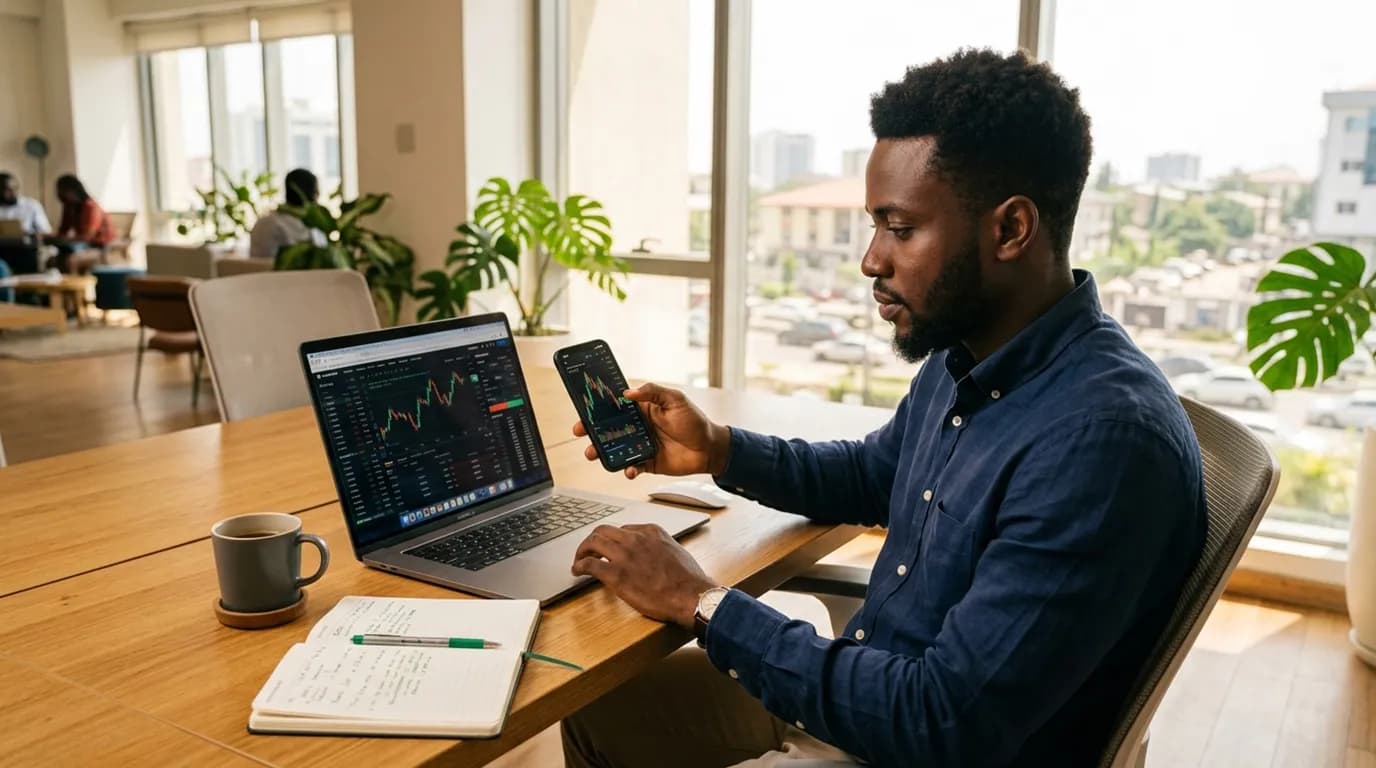
Why Nigerians Are Turning to Forex Trading in 2026
The Growth of Retail Forex Trading in Nigeria
Nigeria now ranks among the top five countries in Africa for retail forex trading activity, with participation growing sharply since 2020. Cheaper smartphones, broader mobile data coverage, and a naira that has lost significant purchasing power against the dollar have all pushed more Nigerians toward currency markets. When your savings erode against USD, trading that relationship starts to look practical, not speculative.
According to the Finance Magnates Intelligence 2024 report, sub-Saharan Africa recorded a 34% year-on-year increase in new retail forex accounts. Nigeria accounts for a significant portion of that growth, driven largely by traders between 22 and 38 years old opening accounts on mobile platforms.
What You Can Realistically Achieve as a Beginner
Be honest with yourself before you start: most beginner traders lose money in their first few months. Not because forex is impossible, but because they skip the fundamentals, overtrade, and take on more risk than their account can absorb. That statistic is not meant to discourage you; it's meant to frame the right expectation.
What a beginner can realistically achieve in the first six to twelve months is a solid understanding of how markets move, a tested approach to managing risk, and, with discipline, a small but consistently profitable track record on a demo or small live account. That foundation is worth more than any early windfall.
What This Guide Will Cover
This guide walks you through how to start forex trading in Nigeria from zero: what is forex trading, how to choose a broker, how to open and fund a Rally Trade account in naira, how to place your first trade, and how to protect your capital with basic risk management. Each section is practical and sequential. If you already know some of this, skip ahead.
What Is Forex Trading? A Simple Explanation for Nigerian Beginners
How the Forex Market Works

The foreign exchange market is where currencies are bought and sold against each other. It operates 24 hours a day, five days a week, across financial centres in Sydney, Tokyo, London, and New York. For Nigerian traders, the London session (9am–6pm WAT) and the New York session (2pm–11pm WAT) are where the highest trading volume and tightest spreads typically occur.
There is no centralised exchange for forex, unlike the Nigerian Stock Exchange. Trades are executed electronically through a network of banks, institutional players, and brokers. Daily turnover exceeds $7.5 trillion according to the Bank of International Settlements 2022 triennial survey, making it the largest financial market on the planet by a wide margin.
Currency Pairs Explained: USD/NGN, EUR/USD, and More

Every forex trade involves two currencies: a base currency and a quote currency. EUR/USD, for example, tells you how many US dollars one euro will buy. If the price is 1.0850, one euro costs $1.0850.
The most traded pairs globally are called majors: EUR/USD, GBP/USD, USD/JPY, USD/CHF. They carry the tightest spreads (the difference between the buy and sell price) and the most liquidity. USD/NGN and USD/ZAR are common pairs for traders who want direct exposure to African currency dynamics, though spreads on these can be wider.
How Traders Make (and Lose) Money in Forex
You profit in forex by correctly predicting whether a currency pair will rise or fall, then buying or selling accordingly. Buy EUR/USD at 1.0850, it moves to 1.0920, you close the trade: that 70-pip move is your profit. Reverse the outcome and it's a loss.
The part beginners underestimate is how fast losses accumulate when leverage is involved. More on that in the risk section, but the core point is this: the same mechanism that makes a 50-pip gain meaningful can make a 50-pip loss account-threatening. Forex is not one-sided.
How to Choose the Right Forex Broker in Nigeria
Key Factors to Look for in a Forex Broker
Choosing a broker is the most consequential decision a beginner makes. Get it right and your trading environment is stable, your deposits are processed cleanly, and your platform executes orders reliably. Get it wrong and the problem won't be your strategy.
The non-negotiables: regulatory oversight, transparent fee structure, fast and local deposit/withdrawal options, a platform that works on your device, and responsive customer support. Secondary but important: educational resources, a demo account option, and realistic leverage caps that don't encourage reckless position sizing.
Why Regulation Matters for Nigerian Traders
An unregulated broker has no formal obligation to process your withdrawal, maintain segregated client funds, or resolve disputes fairly. That's not a theoretical risk. There are documented cases of Nigerian traders losing funds to offshore brokers who simply stopped responding.
Rally Trade operates under regulation through the Financial Commission, which provides trader dispute resolution and a compensation fund for verified claims. That structure gives you a mechanism for recourse. It's not a guarantee of profit, but it is a guarantee of accountability.
Naira Deposits and Local Payment Methods: What to Check
Confirm before you open an account that the broker accepts naira deposits and offers local bank transfer or card options. Many brokers technically accept Nigerian clients but require USD deposits via international wire transfer, which means currency conversion fees, delays, and sometimes CBN-related complications.
A broker with direct NGN deposit functionality saves you time, money, and frustration from day one. For a full walkthrough of how to open a forex account with naira, including supported payment methods and typical processing times, see our dedicated guide.
Why Rally Trade Is a Strong Choice for Traders in Nigeria

Rally Trade is operated by FRNG Nigeria, headquartered at 21 Adeniyi Jones Avenue, Ikeja, Lagos. It is not an offshore platform catering to Nigerians as an afterthought; it was built with Nigerian traders as the primary audience. Naira-denominated accounts, local payment support, Nigerian-based seminars, and customer service that understands the local banking environment are baked into the product.
The platform also offers MT4, MT5, and the proprietary xTrader platform, so you are not locked into a single trading interface. Minimum deposit starts at the equivalent of $100 in naira.
Step-by-Step: How to Open a Forex Trading Account with Rally Trade
Step 1 — Visit Rally Trade and Start Your Registration

Go to rally.trade and register an account by clicking the "Open Account" button. You will be directed to the registration form. Enter your full name, email address, phone number, and country of residence. Choose a strong password and confirm it.
After submitting, check your email for a verification link. Click it to confirm your email address and activate the registration process. The whole step takes under three minutes.
Step 2 — Complete Your Personal Details and Verify Your Identity (KYC)

KYC (Know Your Customer) verification is a regulatory requirement, not an optional step. You will need to provide a valid government-issued ID (National ID card, international passport, or driver's licence) and proof of address (a recent utility bill or bank statement showing your name and address, dated within the last three months).
Upload clear photos or scans of both documents through the client portal. Rally Trade's verification team typically processes submissions within one business day. You cannot make a live deposit until KYC is approved, so submit this early and make sure the documents are legible.
Step 3 — Choose Between a Demo Account and a Live Account

Once verified, you choose your account type. A demo account gives you virtual funds (typically $10,000) to practise with in real market conditions. A live account uses your actual deposit.
Start with the demo. Seriously. The platform interface, order types, and market behaviour take time to get comfortable with, and making those early mistakes with virtual money costs you nothing. Move to live only when you can execute trades confidently and maintain consistent risk discipline over at least two to four weeks of demo trading.
Step 4 — Set Up Your Trading Platform (Web, Desktop, or Mobile)
Rally Trade supports three platform options: xTrader (the proprietary web and mobile platform), MetaTrader 4 (MT4), and MetaTrader 5 (MT5). For beginners, xTrader is the most straightforward starting point because it was designed with accessibility in mind and integrates directly with your Rally Trade account dashboard.
MT4 and MT5 are industry-standard platforms used by professionals worldwide. If you plan to use automated strategies (Expert Advisors) or want access to more advanced charting tools, MT5 is the better long-term choice. Download links for desktop and mobile versions are available in your Rally Trade client portal.
How to Make Your First Deposit in Naira (NGN)
Accepted Payment Methods for Nigerian Traders
Rally Trade accepts deposits through local Nigerian bank transfer, debit/credit card, and cryptocurrency. The naira deposit option means you transfer directly in NGN; the platform converts to your account's base currency at the prevailing rate. Crypto deposits (USDT, BTC, and others) are also supported for traders who prefer that route.
Do not use a third-party account to fund your trading account. The name on your bank account or card must match the name on your Rally Trade account. Mismatched funding sources will delay processing and may trigger a compliance review.
How to Fund Your Rally Trade Account Step by Step

Log into your Rally Trade client portal, navigate to the "Deposit" section, and select your preferred payment method. Enter the deposit amount in naira, confirm the transaction details, and follow the prompts for your chosen method.
Bank transfers typically reflect in your account within a few hours during business days. Card deposits are usually instant. Once funds are credited, you will see the balance reflected in your platform account and you can begin trading.
Minimum Deposit Requirements and What to Know About Fees
The minimum deposit is the equivalent of $100 in naira. At the time of writing, that is approximately ₦160,000 to ₦170,000 depending on the current USD/NGN rate, but that figure fluctuates as exchange rates move. Check the current naira equivalent on the Rally Trade deposits page before transferring.
Rally Trade does not charge deposit fees on its end. However, your bank may apply its own transfer charges, particularly for online transactions. Factor that into your calculation.
How to Place Your First Forex Trade on Rally Trade
Navigating the Rally Trade Platform as a Beginner
Open xTrader and take five minutes to orient yourself before touching a trade. The main panel shows your watchlist of available instruments. The chart view displays live price action. The order panel is where you set trade parameters. The portfolio/positions tab shows your open trades and account balance.
Spend time on the demo account clicking through each section. Knowing where things are matters more than you think when you are in a live trade and need to act quickly.
Selecting a Currency Pair and Reading a Live Quote
Click on EUR/USD in your watchlist. You will see two prices: the bid (sell) price and the ask (buy) price. If EUR/USD shows 1.0847 / 1.0849, the difference of 2 pips is the spread; that is your transaction cost for entering the trade.
If you believe EUR/USD will rise, you click Buy. If you believe it will fall, you click Sell. You are always buying the base currency (EUR) and selling the quote currency (USD), or vice versa. Keep it that simple at first; do not trade more than one or two pairs until you understand how each one moves.
Setting Your Trade Size, Stop Loss, and Take Profit

Trade size in forex is measured in lots. One standard lot is 100,000 units of the base currency. A micro lot (0.01) is 1,000 units and is the appropriate size for a beginner on a small account. On EUR/USD, a 1-pip move on a micro lot equals roughly $0.10. On a standard lot, the same 1-pip move equals $10. Size matters enormously.
Before you click execute, set your stop loss (the price level at which the trade automatically closes if it moves against you) and your take profit (the level at which it closes in your favour). Both fields are available in the order panel. Do not skip them. A trade without a stop loss is a trade with no ceiling on how much you can lose.
Executing the Trade and Monitoring Your Open Position
Once your parameters are set, click "Buy" or "Sell" to execute. The trade appears immediately in your open positions panel. You can see your floating profit or loss updating in real time.
Resist the urge to close a trade the moment it goes slightly negative. That is normal market movement. What matters is whether the price reaches your stop loss or take profit, which you set based on analysis before you entered. If you find yourself staring at the screen and second-guessing every tick, that is a sign your position size is too large for your current comfort level.
Forex Risk Management Basics Every Nigerian Beginner Must Know
Understanding Leverage and Why It Cuts Both Ways

₦160,000 deposited. 1:100 leverage selected. EUR/USD drops 50 pips during the London session open. Account balance: ₦80,000. That happened in under two hours, on a trade that felt reasonable at the time.
Leverage lets you control a position much larger than your deposit. At 1:100, your ₦160,000 controls a position worth ₦16,000,000. Every pip of movement is magnified by the same ratio. That works spectacularly in your favour when you are right, and devastatingly against you when you are wrong. High leverage is not a tool for beginners to maximise returns; it's a tool that requires experience to use safely.
The 1–2% Rule: How Much to Risk Per Trade
Never risk more than 1–2% of your account balance on a single trade. On a ₦160,000 account, that means a maximum loss per trade of ₦1,600 to ₦3,200. Small numbers, yes. But this rule is what keeps you in the game long enough to actually learn.
Traders who risk 10–20% per trade can be right six times in a row and still blow their account on the seventh. The 1–2% rule is not conservative thinking; it's probability management.
Using Stop Loss Orders to Protect Your Capital
Set a stop loss on every trade before you enter. Not after. Not "most of the time." Every single one.
Your stop loss should be placed at a technically logical level, not at a random distance or at the point where you "can't bear any more loss." Common approaches include placing it just below a recent support level for buy trades, or just above a resistance level for sell trades. The distance between your entry and your stop loss then determines your position size, not the other way around.
Common Mistakes Nigerian Beginners Make and How to Avoid Them
Overtrading is the single most destructive habit in early forex careers. Opening four or five positions simultaneously because "the market is moving" spreads your attention and your capital too thin. Do not trade more than two pairs at once until you have at least six months of consistent experience. See our guide to the best currency pairs to trade if you are unsure where to start.
A few other patterns worth naming:
- Chasing losses: Doubling your position size after a loss to "win it back" is how small losses become account-ending ones. If you hit your daily loss limit, close the platform and come back tomorrow
- Ignoring economic news: Major data releases like the US Non-Farm Payrolls report (released the first Friday of each month) cause violent, unpredictable short-term price swings. As a beginner, avoid holding trades through high-impact news events. Check an economic calendar before you trade
- Using untested signals from social media: Telegram groups and Instagram "forex gurus" posting screenshots of winning trades are not a substitute for understanding what you are doing. Many of these "signals" are selectively shared; the losing trades don't make the highlight reel
Continue Learning: Rally Trade Seminars and Education in Nigeria
Free Forex Seminars in Lagos, Abuja, Port Harcourt, and Ibadan
Rally Trade runs in-person forex seminars across Nigeria's major cities: Lagos, Abuja, Port Harcourt, and Ibadan. These sessions are designed for beginners and intermediate traders, covering platform navigation, trading strategies, and risk management in a hands-on environment.
If you learn better face-to-face than from a screen, attending one of these seminars early in your journey is genuinely useful. You also get direct access to experienced traders and the chance to ask questions in real time. Keep an eye on the Rally Trade website and social media channels for upcoming dates and registration details.
Online Resources, Webinars, and the Rally Trade Education Hub
The Rally Trade education hub offers written guides, video tutorials, and scheduled webinars covering everything from the basics of forex to advanced chart reading. The material is structured for Nigerian traders, meaning examples use relevant currency pairs and account for local market context.
Webinars are particularly useful because they are interactive; you can ask questions during the session. Complement this with practice on your demo account, and you will consolidate theory into actual skill far faster than reading alone.
Start Your Forex Trading Journey in Nigeria Today
Practice First: Open a Free Demo Account with Rally Trade
A demo account costs nothing and risks nothing. You get real market conditions, real price feeds, and a real platform experience without committing a single naira. Every serious trader started here. The demo is also the best place to test whether a strategy actually works before you put money behind it.
Open a free demo account today and spend at least two weeks practising before you consider a live deposit. Use that time to learn the platform, get comfortable with order types, and build a basic routine around when you trade, how you analyse the market, and how you manage your risk.
Your Next Steps as a Beginner Forex Trader in Nigeria
Here is a practical sequence to follow over your first 30 days:
- Open your Rally Trade demo account and complete the KYC process in parallel, so you are verified and ready to go live when you choose
- Spend two to four weeks on demo trading EUR/USD or GBP/USD only. Focus on executing clean trades with proper stop losses, not on maximising virtual profit
- Attend a Rally Trade seminar or webinar to supplement your platform practice with structured learning
- Make your first naira deposit only when you feel consistently comfortable with your demo performance and understand how leverage affects your position
- Start small on live. A micro lot on a ₦160,000 account keeps each trade loss well within the 1–2% rule and gives you space to learn from real market conditions without catastrophic risk
Learning how to start forex trading in Nigeria the right way takes weeks, not days. The traders who last are the ones who treat the early phase as education, not as a fast track to income.
Trading involves significant risk and is not suitable for all investors. Past performance is not indicative of future results. Only trade with funds you can afford to lose. Ensure you fully understand the risks of leveraged products before committing capital.
Frequently Asked Questions
Is forex trading legal in Nigeria?
×
Yes, forex trading is legal in Nigeria. The Central Bank of Nigeria (CBN) regulates foreign exchange activity, and Nigerian traders are permitted to trade forex through internationally regulated brokers. It is important to choose a broker that holds a valid licence from a recognised financial authority to ensure your funds are protected.