News Trading in Forex: How to Trade the US CPI Print
Master news trading in forex using the US CPI print as your worked example. Learn whether to scalp or swing the release, plus how to survive the spread widening and slippage that trip up most traders.

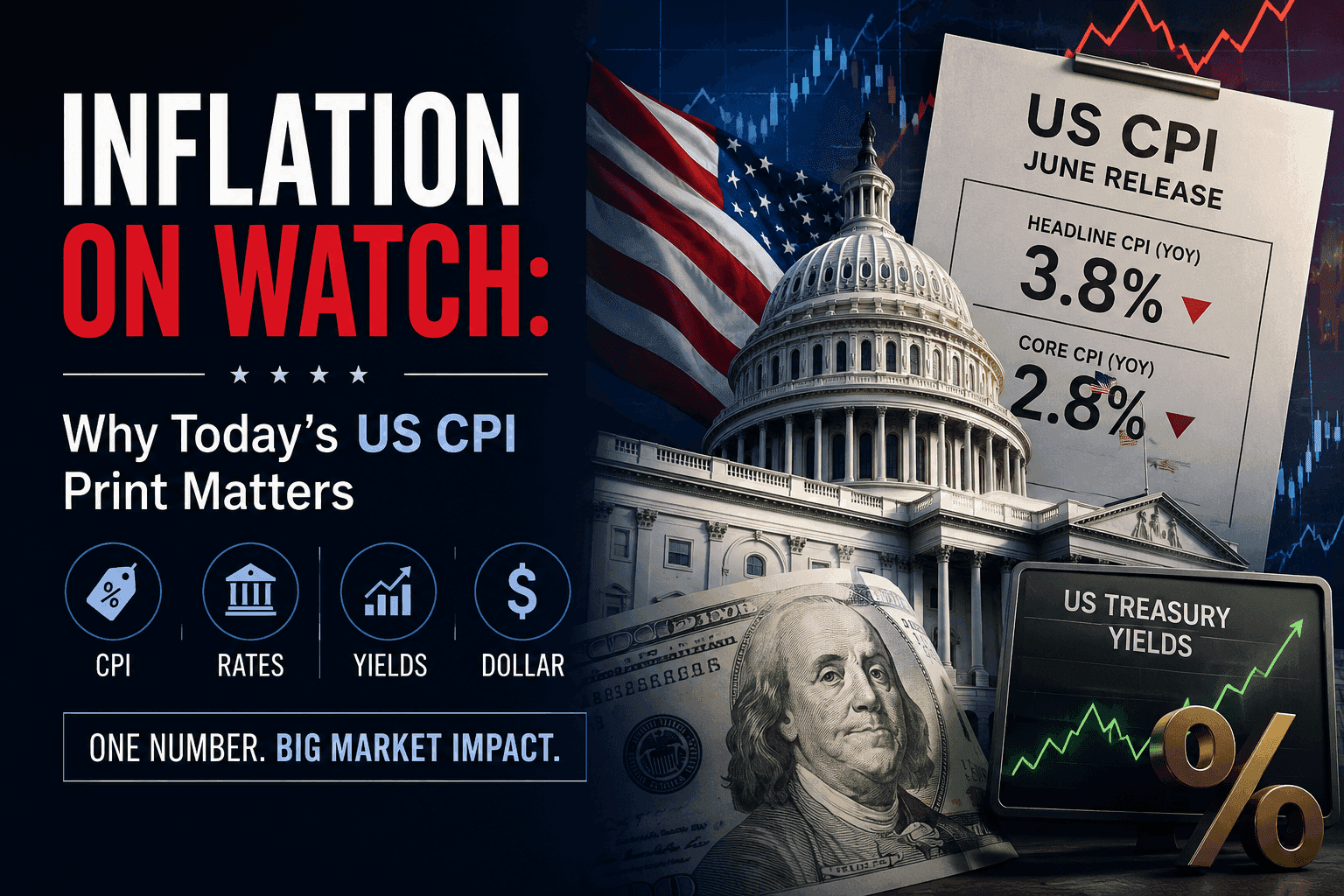
What Is News Trading (and Why High-Impact News Moves Forex)
At 1:30pm New York time on a CPI day, EUR/USD can travel 80 pips in under a minute. The same pair might have moved 15 pips in the previous three hours combined. That single data point rearranged the entire session. News trading is the practice of positioning around scheduled economic releases like this one, and it's one of the most misunderstood approaches in the market.
The core idea is simple. Certain announcements carry enough weight to reprice a currency in seconds. Traders who follow this style build their decisions around when the data drops, not around a chart pattern that formed overnight.
How Economic Data Shifts Currency Prices
Currencies move on expectations about interest rates, and interest rates move on economic data. When US inflation comes in hotter than forecast, markets start pricing in the possibility that the Federal Reserve keeps rates higher for longer. Higher rates tend to attract capital, so the dollar strengthens against pairs like EUR/USD and GBP/USD.
The key word is surprise. The market has already baked the forecast into current prices. If analysts expect CPI at 3.2% and it prints at 3.2%, the reaction is often muted. But a print of 3.6% against a 3.2% forecast? That gap is what fuels the violent move. Traders react to the difference between what was expected and what actually happened.
Why High-Impact News Creates Both Opportunity and Danger
Volatility cuts in two directions, and beginners tend to notice only one of them. A big move means a big potential gain if you're on the right side. It also means a big loss, executed at brutal speed, if you're not.
High impact news forex events compress hours of price movement into seconds. That compression is the opportunity. It's also why spreads blow out, stops get skipped, and orders fill at prices you never agreed to. We'll get to all of that. For now, understand that the same force that draws traders to these releases is the force that empties accounts on them.
The Big Three: CPI, NFP, and FOMC Explained
Three US releases dominate the forex calendar for dollar pairs. Learn these before anything else, because they cause more sudden movement than almost every other scheduled event combined. Everything else is secondary noise by comparison.
US CPI: The Inflation Print That Moves the Dollar
CPI stands for the Consumer Price Index, and it measures how much the prices of everyday goods and services changed over the past month. In plain terms: it's the official inflation number. It comes out monthly, usually around the middle of the month, published by the US Bureau of Labor Statistics.
Why does the market care so much? Because the Fed's job is to control inflation, and CPI is the scoreboard. A hot number pressures the Fed toward tighter policy; a cool number gives them room to ease. Traders watch two figures: the headline CPI and the "core" CPI, which strips out volatile food and energy prices. Core is often the one that moves markets hardest, because it reflects underlying inflation trends the Fed can't dismiss as temporary.
NFP: The Monthly Jobs Report Traders Watch
Non-Farm Payrolls tells you how many jobs the US economy added or lost in the previous month, excluding farm workers. It lands on the first Friday of most months. NFP trading has a reputation for chaos, and it earns it.
The complication with NFP is that it's three data points in one release: the payrolls figure, the unemployment rate, and average hourly earnings. These can contradict each other. Strong job growth with weak wage growth sends a mixed signal, and the market sometimes lurches one way, reverses, then lurches back within ninety seconds as traders digest the conflict. If you want a lesson in whipsaws, watch an NFP print live before ever risking money on one.
FOMC: When the Fed Sets the Tone
The Federal Open Market Committee sets US interest rates, and its announcements are the heavyweight of the calendar. Eight times a year, the Fed publishes its rate decision, followed roughly thirty minutes later by a press conference with the Chair.
Here's what makes FOMC different from CPI and NFP: the rate decision is often already priced in, but the tone of the statement and press conference is not. A single sentence about future policy can move the dollar more than the rate decision itself. The move isn't a clean spike; it stretches across the statement and the presser, which can run for an hour of jagged, headline-driven swings.
What Actually Happens at a CPI Release: The Honest Reality
Let me describe a real CPI moment. A trader in Lagos has GBP/USD on a 0.8 pip spread at 1:29pm WAT. The print drops. Within two seconds, that spread balloons to 12 pips. Their pending order fills 9 pips away from where they wanted it. Price spikes up, snaps their stop, then reverses hard in the direction they originally wanted. They took a full loss on a trade that would have won. This is normal. This is CPI.
Spread Widening and Why Your Costs Spike
The spread (the gap between the buy and sell price) doesn't stay fixed during news. Liquidity providers widen it dramatically the moment data hits, because nobody wants to offer tight prices when the market is about to lurch unpredictably.
That EUR/USD spread you're used to seeing at under a pip can hit 10, 15, sometimes 20 pips in the first seconds of a CPI release. Your trade needs to move 15 pips just to break even before you've made anything. If you scalp for 20-pip targets, half your target just evaporated into cost. Factor this in before you even think about entering.
Slippage and Failed Fills
Slippage is when your order executes at a worse price than you requested, and during news it's not a bug: it's the environment. Markets move faster than orders can fill.
You click to buy at 1.0850. Between your click and the execution, price is already at 1.0863. You're filled 13 pips higher than planned. The same thing happens to stop losses, which is worse. A stop set at 1.0800 might fill at 1.0785 because price gapped straight through your level. Your risk was never really what you calculated it to be.
Whipsaws and Stop-Hunts in the First Seconds
The first ten to thirty seconds after a print are the most dangerous window in trading. Price often spikes one direction, reverses, then settles in a third. Algorithms hunt clustered stop-loss orders, triggering them before the "real" move begins.
Retail traders love to place stops at obvious round numbers. The market knows this. Those levels get swept in the initial chaos, taking out positions that had the right idea but the wrong survival plan. If your stop is sitting where everyone else's is, expect it to get hit.
Approach 1: Scalping the Print
Scalping the print means entering within seconds of the release and aiming for a fast move in your direction, then getting out. It's the highest-risk, highest-adrenaline version of news trading, and it's the one most beginners are drawn to for exactly the wrong reasons.
Who This Style Suits
This suits experienced traders with fast execution, deep familiarity with a single pair's behaviour, and the emotional discipline to accept slippage without tilting. Not many people. If you hesitate on entries, if a 15-pip adverse move makes your hands shake, or if you're still learning to read your platform, this is not your approach yet.
Scalpers who do this well usually have a plan for both outcomes before the number prints. Hot number: buy the dollar. Cool number: sell it. They're not analysing in the moment; the moment is too fast for analysis. They're executing a pre-decided script.
The Risks of Trading the Spike
The costs are stacked against you at the exact moment you're most exposed. Wide spreads eat your entry, slippage moves your fills, and the whipsaw can hit your stop before the trend you predicted actually arrives. You can be completely right about the direction and still lose the trade.
Don't scalp the print with a large position because "the move is obvious." The move is never obvious in the first five seconds, and the size that feels exciting on the way in is the size that hurts most when the fill comes in 12 pips against you.
Approach 2: Swing Trading the Post-News Trend
The market often gives you a cleaner opportunity fifteen minutes after the print than fifteen seconds after it. The initial spike is noise. The trend that follows, once liquidity returns and spreads normalise, can run for hours. Trading that trend is the calmer, more forgiving side of news trading.
Waiting for the Dust to Settle
Instead of firing at the release, you sit on your hands through the chaos. You let the spread come back down. You let the stop-hunt play out. Then, with a clearer picture and normal trading costs, you look for an entry in the established direction.
A CPI print at 1:30pm WAT might cause thirty seconds of madness, but by 1:50pm the dollar's genuine reaction is usually visible on the chart. Spreads are tighter, execution is more reliable, and you're trading the actual repricing rather than the algorithmic frenzy around it.
Reading the Direction After the Noise
Once the initial spike settles, price frequently retraces part of the move before continuing. That retracement gives swing traders a more sensible entry with a stop that isn't sitting in the kill zone. You're looking for confirmation: has the dollar held its gain twenty minutes on? Is the move backed by the direction the data implied?
This approach underperforms when the release is a non-event and there's no clean trend to follow. Some CPI prints land exactly on forecast and the dollar just chops sideways. On those days, the right swing trade is no trade.
Approach 3: Standing Aside (A Legitimate Strategy)
Not trading a CPI release is a decision, not a failure. Some of the most consistent traders close their positions before major news and reopen after the dust clears. They've decided the risk-to-reward of the spike doesn't suit them, and that's a professional call.
Why Doing Nothing Can Protect Your Capital
Consider a swing trader holding a EUR/USD position that's up nicely. CPI is due in twenty minutes. A hot print could reverse the entire gain in seconds, with slippage guaranteeing they exit worse than their stop. Closing before the print locks in the win and removes exposure to a coin-flip event.
You are never obligated to trade. The market runs 24 hours; there is always another setup. Sitting out a release you don't understand, or one where the spread cost simply isn't worth it, preserves the capital you need for the trades that actually fit your edge. Missing a move costs you nothing. Being on the wrong side of a CPI spike with oversized risk can cost you the account.
News-Trading Rules and Risk Management
A news trading strategy without strict risk rules is just gambling with extra steps. The releases are predictable in timing but not in outcome, which means your protection has to come from how you size and time your entries, not from predicting the number.
Sizing Positions for Volatile Conditions
Cut your normal position size for news trades. If you usually risk 1% of your account per trade, a news trade justifies less, not more, because slippage means your actual risk exceeds your intended risk. A stop that should have limited you to a ₦20,000 loss can easily become ₦28,000 when price gaps through it.
Assume your stop will slip. Plan for the worse fill, size for it, and you won't be blindsided when it happens.
Never Enter in the Seconds Before the Print
Placing a market order in the final ten seconds before a release is one of the worst habits in news trading. Spreads are already widening in anticipation, liquidity is thinning, and you're entering blind into an event you can't predict.
If you're going to trade the release, be positioned early with a plan or wait until after. The pre-print window is the danger zone with none of the reward.
Let the Initial Spike Settle Before Acting
Give the market thirty to sixty seconds minimum after the number lands. The first spike is where fills are worst and reversals are sharpest. Let the spread contract and the direction firm up. Patience of even one minute filters out a large chunk of the environment's worst behaviour.
How to Prepare: Building an Economic Calendar Routine
Preparation is what separates news traders from people who get caught by surprise moves. The releases are scheduled weeks in advance. There is no excuse for a major print catching you off guard, yet it happens constantly to traders who never check a calendar.
CPI and NFP Release Times in WAT for Nigerian Traders
US CPI is typically released at 8:30am New York time, which is 1:30pm WAT during most of the year (2:30pm WAT when the US is on standard time in the northern winter, since Nigeria doesn't observe daylight saving). NFP follows the same 8:30am NY schedule, landing around 1:30pm WAT on the first Friday of the month.
FOMC rate decisions come out at 2:00pm New York time, which is 7:00pm WAT, with the press conference at 7:30pm WAT. Mark these in your own timezone so you're never guessing. Check the Rally Trade economic calendar for the exact scheduled times each month, since daylight saving shifts the US times twice a year.
A Pre-News Checklist Before Every Major Release
Run through the same routine every time. Know the forecast number and the previous reading, so you can judge whether the print is a surprise. Check your open positions and decide, in advance, whether you're holding or closing them through the event. Confirm your position size is reduced for volatility. Decide your approach before the print, not during it: are you scalping, waiting to swing, or standing aside? And confirm you have no pending orders sitting in the obvious stop-hunt zones. A trader who walks in with this checklist done is playing a completely different game from one who's reacting live.
Trade the News Smarter with Rally Trade
News trading rewards preparation and punishes improvisation. The traders who last are the ones who respect the volatility, size down for it, and often decide the smartest move is to stand aside. Rally Trade gives you the MT5 platform, an economic calendar to plan around, and in-person seminars across Nigerian cities where our team walks through releases like CPI and NFP in detail. Learn the mechanics properly before you put real money in front of a print.
Trading involves significant risk and is not suitable for every investor. Past performance offers no guarantee of future results. Only commit funds you can genuinely afford to lose, and make sure you fully understand the risks of leveraged products, especially during high-impact news events, before you trade.
Frequently Asked Questions
What is news trading in forex?
×
News trading in forex is the practice of positioning around scheduled economic releases like the US CPI print, NFP jobs report, or FOMC rate decision. Instead of relying on chart patterns, traders build their decisions around when high-impact data drops and how the actual figure compares to market expectations. The gap between forecast and reality is what fuels rapid currency moves, making this a high-volatility approach that demands strict risk management.