Is Forex Trading Legal in Nigeria? What You Need to Know
Forex trading is legal in Nigeria — but knowing how to spot a legitimate broker is what protects your money. Learn what the CBN says, how regulation works, and what red flags to avoid.

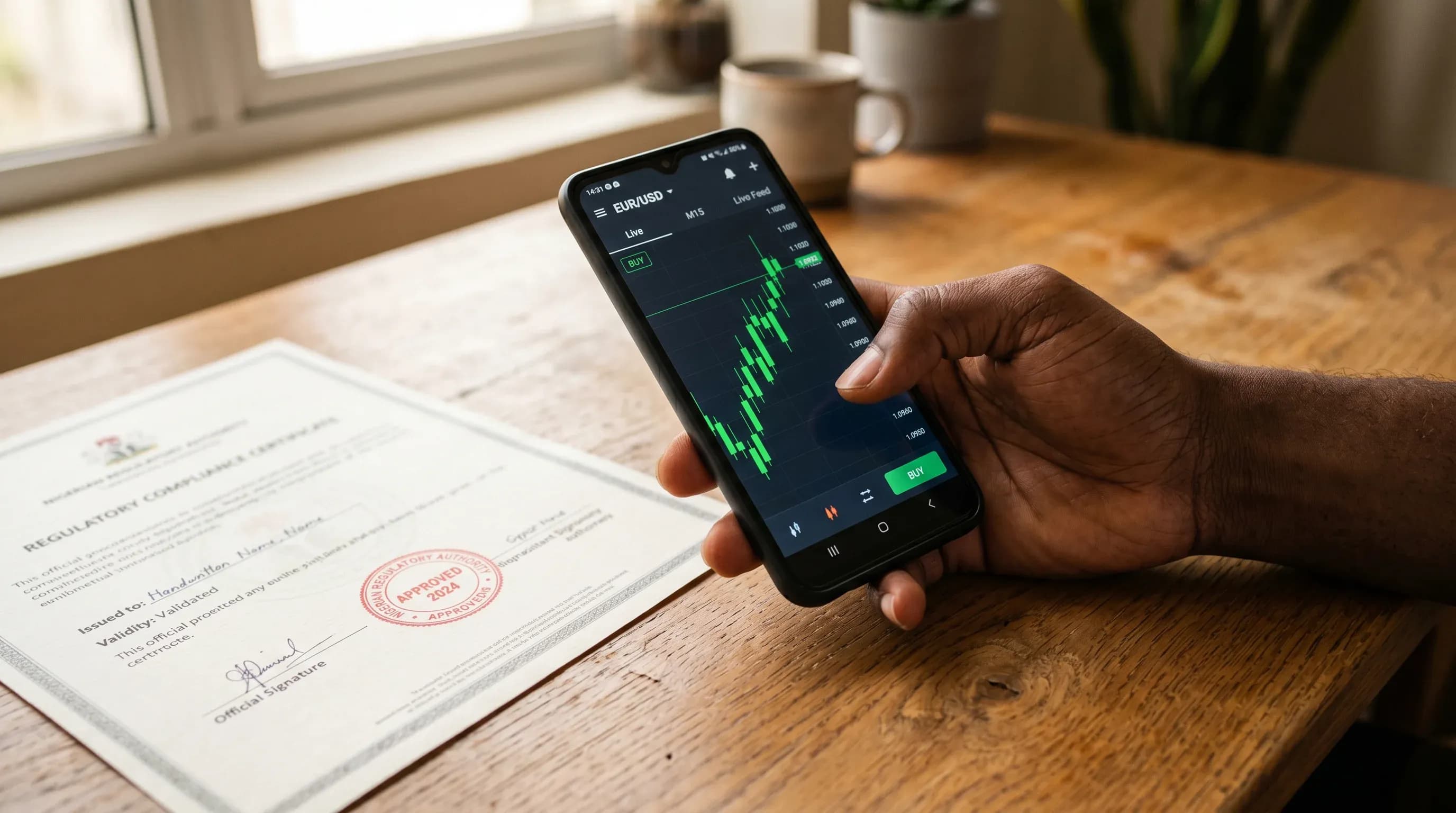
Is Forex Trading Legal in Nigeria? The Short Answer
Forex trading is legal in Nigeria. Nigerian citizens can legally participate in the foreign exchange market, open accounts with international brokers, and trade currency pairs, indices, commodities, and other financial instruments online. There is no law that prohibits a Nigerian resident from trading forex as an individual retail trader.
That said, legality comes with context. The environment around forex trading in Nigeria is complicated by a wave of scams, unregistered operators, and fraudulent investment schemes that have cost thousands of Nigerians significant amounts of money. Understanding what the law actually says, and how to separate legitimate trading from fraud, is what this article covers.
Why So Many Nigerians Ask This Question
A trader in Lagos searches for a broker, deposits funds, and three months later cannot withdraw a kobo. The broker's website goes dark. The WhatsApp group admin disappears. The "investment platform" that promised 30% monthly returns stops responding to emails. These stories are not rare, and they have created understandable scepticism about whether the whole thing is above board.
The confusion is compounded by occasional CBN (Central Bank of Nigeria) directives that restrict certain foreign exchange transactions, which some people interpret as a blanket ban on forex trading. It is not. Policy restrictions on FX allocation or bank transfers are separate from the legality of individual retail trading activity.
Clearing Up the Confusion: Legal Activity vs. Unregulated Scams
The distinction is straightforward: trading forex yourself through a registered broker is a legal activity. Operating an unlicensed investment scheme where you collect funds from other Nigerians and promise returns is not. Most of the horror stories that circulate online about "forex" are actually stories about the second category. The activity itself is legitimate; the problem is the operators running fraudulent structures under its name.

The Legal Status of Forex Trading in Nigeria
What Nigerian Law Says About Retail Forex Trading
No specific Nigerian statute prohibits an individual from trading forex. The Foreign Exchange (Monitoring and Miscellaneous Provisions) Act of 1995 governs foreign exchange transactions in Nigeria, but its focus is on institutional players, bureaux de change, and macroeconomic management rather than retail trading activity. Individual traders opening accounts with international brokers and trading their own capital are not in breach of Nigerian law.
The Investment and Securities Act (ISA) 2007 — currently being updated — governs capital markets activities in Nigeria and grants the SEC regulatory authority over investment and securities businesses. Retail forex trading with a properly structured broker falls outside the category of activity that requires a domestic licence, though any entity soliciting investments from Nigerians is subject to SEC oversight.

The Difference Between Trading Forex and Running an Unlicensed Forex Business
This is the line most people miss. You trading your own funds on a regulated platform: legal. You collecting money from twenty friends, trading on their behalf without a fund management licence, and promising them monthly returns: illegal, regardless of how you market it.
SEC Nigeria has repeatedly warned the public about unlicensed investment schemes disguised as forex trading businesses. The warning is not against forex trading; it is against unregistered fund management and collective investment schemes. If someone asks you to invest with them so they can trade on your behalf, check their registration status with SEC Nigeria before sending a single naira.
Can Nigerians Trade Forex Online With International Brokers?
Yes. There is no legal restriction on a Nigerian resident opening and funding an account with an internationally regulated broker. Millions of Nigerians already do this. The practical considerations involve payment methods, FX transfer limits, and the due diligence required to choose a broker worth trusting — not legality.
The Central Bank of Nigeria (CBN) and Forex Trading
CBN's Role in Nigeria's Foreign Exchange Market
The CBN manages Nigeria's foreign exchange reserves, sets monetary policy, and regulates commercial banks and licensed financial institutions. Its primary interest in the FX market is macroeconomic: managing the naira exchange rate, controlling capital flows, and ensuring financial system stability. It does not regulate retail forex brokers and does not license them.
When the CBN makes pronouncements about forex, the concern is typically about dollar scarcity, FX allocation to sectors of the economy, or remittance channels. A directive restricting bank FX sales is a monetary policy tool, not a ban on trading.
CBN Guidelines That Affect Retail Forex Traders
There are a few practical ways CBN policy touches retail traders. Banks may restrict the use of naira debit cards for offshore transactions above certain limits, which can affect how traders fund international broker accounts. CBN has also at various points tightened FX transfer rules for commercial banks, meaning some funding channels require alternative routes such as domiciliary accounts or crypto deposits.
None of these restrictions make forex trading illegal. They create friction around funding and withdrawals, which is why many traders use crypto as a deposit method or work with brokers that offer localised Naira payment options.

What the CBN's Position Means for Everyday Traders
The practical takeaway: the CBN is not your adversary as a trader, but it is also not your regulator. Its rules govern the banking system, not the trading platform you use. Your responsibility as a retail trader is to comply with applicable FX transfer rules when funding accounts, work with brokers that operate transparently, and keep records of your trading activity for tax purposes.
Nigeria's Finance Act and personal income tax framework technically require individuals to declare income from trading activities. Few retail traders engage with this in practice, but it is part of operating legally.
The Securities and Exchange Commission (SEC) Nigeria and Capital Markets
SEC Nigeria's Oversight of Investment and Trading Activities
SEC Nigeria is the primary capital markets regulator in the country. It registers investment advisers, fund managers, stockbrokers, and capital market operators. Any entity offering investment management services to Nigerians — including forex fund managers — is required to be registered with SEC. The Commission also oversees collective investment schemes and has authority to act against unregistered operators.
As of 2022, SEC Nigeria issued a framework for digital assets and virtual currency, signalling its intention to expand oversight into crypto and related markets. The regulatory landscape is evolving, but the core principle is unchanged: if someone is managing your money or soliciting investments, they need to be registered.
How SEC Nigeria Protects Traders From Fraudulent Schemes
SEC regularly publishes warnings about fraudulent investment platforms. Its investor education portal and public notices name specific platforms and individuals operating without authorisation. Before committing funds to any Nigerian-based forex or investment outfit, searching SEC Nigeria's register at sec.gov.ng takes under two minutes and could save you significantly more than that.
The Commission also has an investor protection fund and an enforcement division. Neither moves quickly enough to recover funds once a scam collapses — prevention matters far more than enforcement after the fact.
International Forex Regulation and Why It Matters to Nigerian Traders
How International Regulatory Bodies Fill the Gap
Most reputable forex brokers serving Nigerian traders are regulated internationally. Bodies like the UK's Financial Conduct Authority (FCA), the Australian Securities and Investments Commission (ASIC), and Cyprus's CySEC set capital requirements, client fund segregation rules, and operational standards that Nigerian retail traders benefit from indirectly. A broker regulated by a Tier 1 authority has legal obligations that a completely unregulated entity does not.
When evaluating a broker, look for verifiable regulatory credentials, not just logos on a website. Regulators publish public registers; a broker claiming FCA authorisation can be verified at register.fca.org.uk in seconds.

The Financial Commission: An Independent Dispute Resolution Body
The Financial Commission is an independent, self-regulatory organisation that provides dispute resolution services for forex and CFD traders. Unlike government regulators, it operates as an external complaint and arbitration mechanism. Member brokers agree to abide by its rulings, and the Commission maintains a compensation fund covering up to €20,000 per verified complaint.
For traders who use brokers operating outside major regulatory jurisdictions, the Financial Commission provides a meaningful layer of accountability. It is not equivalent to FCA or ASIC regulation, but it is a concrete mechanism for resolving disputes that would otherwise leave traders with no recourse at all.
Why Rally Trade's Membership in the Financial Commission Matters to You
Rally Trade is a member of the Financial Commission. That membership means if you have a dispute with the platform that cannot be resolved directly, you have an independent third party to escalate to. The compensation fund provides financial backing to that process. No legitimate broker operating in a regulatory grey area should be unwilling to explain how client disputes are handled; Rally Trade's membership answers that question clearly.
How to Verify Whether a Forex Broker Is Legitimate
Check the Broker's Regulatory Credentials
Don't accept a broker's self-declaration at face value. Every credible regulatory body maintains a public register. Check the regulator's website directly, search the broker's name and licence number, and confirm the status is active. If a broker claims to be regulated but the licence number doesn't appear on the regulator's register, treat it as unregulated.
Also look at how long the broker has been operational. A company registered six months ago with no verifiable track record deserves more scrutiny than one with several years of documented operation.
Review Transparency: Company Information, Fees, and Policies
A legitimate broker publishes its registered company name, physical address, regulatory information, fee structure, and legal documents publicly. If you cannot find the spread (the difference between buy and sell price), overnight swap rates, or withdrawal terms listed somewhere on the website, that is a problem. Hidden fees don't disappear; they appear later when you're trying to get your money out.
Also verify that the website lists a real physical address and multiple contact channels. Rally Trade, for instance, is headquartered at 21 Adeniyi Jones Avenue, Ikeja, Lagos, and operates physical offices with in-person support. That kind of presence is harder to fake.
Test Customer Support and Withdrawal Processes Before You Commit
Make a small deposit first. Then make a small withdrawal. See how long it takes. Contact customer support with a non-urgent question and observe the response time and quality. These tests cost relatively little and reveal far more about how a broker actually operates than any marketing material ever will.
A broker that delays small withdrawals or creates unnecessary friction on a minor support query will not improve when the amounts get larger.
Red Flags of Forex Scams in Nigeria
Guaranteed Profits and Unrealistic Return Promises
Any operator promising fixed monthly returns from forex trading is either lying or operating a Ponzi scheme. Forex is a market; markets fluctuate. Professional fund managers with decades of experience don't guarantee consistent monthly returns, because they can't. Anyone claiming otherwise is not trading; they are recycling earlier investors' capital to pay earlier participants until the structure collapses.
Thirty percent per month is 360% per year. No sustainable trading strategy operates at that level consistently. (If you've wondered is forex trading gambling, this kind of promise is exactly why the question comes up.) When someone promises you those numbers, the only guaranteed outcome is that someone loses money — and it will not be them.

Unregistered Signal Groups and Ponzi-Style Investment Schemes
Paid Telegram or WhatsApp signal groups are not inherently scams, but many operate without any regulatory standing and charge subscription fees for trade signals that are speculative at best. The bigger danger is groups that migrate from selling signals to "managing accounts" or "investment packages" where members send funds to the group operator.
That transition from signals to fund management is where SEC registration becomes mandatory. Very few of these groups have it.
Pressure Tactics, Withdrawal Blocks, and Disappearing Brokers
If a broker is urgently pushing you to deposit more, dangling bonuses contingent on larger deposits, or making reasons to delay your withdrawal sound reasonable every week, you are already inside a problematic structure. Legitimate brokers don't pressure clients to increase deposits; the relationship is in the broker's long-term interest only if the client actually trades successfully and stays on the platform.
Withdrawal blocks are the clearest signal. If you cannot withdraw what the platform shows as your balance, the balance is fictional. For a step-by-step checklist on how to avoid forex scams in Nigeria, including how to verify broker credentials before depositing, see our dedicated guide.
Why Trading With a Regulated Broker Protects Your Money
Accountability, Fund Safety, and Dispute Resolution
Regulated brokers face legal consequences for misusing client funds. Most credible regulators require brokers to hold client funds in segregated accounts, separate from the company's operational capital. This means if a broker goes bankrupt, your trading balance is not part of the assets creditors can claim. Unregulated brokers have no such requirement, and when they collapse, client funds disappear with everything else.
Dispute resolution is similarly meaningful. A broker accountable to a regulatory body or independent body like the Financial Commission has an external authority that can compel action. That changes the dynamic significantly compared to trying to recover funds from an unregistered operator.
How Rally Trade Maintains Transparency and Compliance
Rally Trade operates under the regulatory oversight of the Financial Commission and publishes its company information, terms of service, and trading conditions openly. The platform offers MT4, MT5, and the proprietary xTrader platform, with Naira-denominated accounts and clear fee structures. In-person seminars across Nigerian cities mean clients can speak with real people about the platform, and the company's physical Lagos office provides a level of accountability that online-only operations cannot.
Trading with a regulated broker does not eliminate trading risk; markets can and do move against any position. What regulation removes is the additional risk of losing money not to the market, but to the broker itself.
Start Trading Forex Legally and Safely With Rally Trade
Forex trading is legal in Nigeria, accessible to any adult with a stable internet connection and a funded account, and a genuine opportunity to develop a financial skill. The threat to most traders is not the law; it is the prevalence of fraudulent operators who have contaminated the space with scams.
The way to answer the question "is forex trading legal in Nigeria" in practice, for yourself, is to choose a broker whose credentials you can verify, whose withdrawal process works, and whose regulatory standing gives you a real mechanism if something goes wrong. That is what the research in this article points toward, and it is what Rally Trade is built to provide.
If you want to understand how Rally Trade is structured, who regulates it, and what protections apply to your account, see our regulation & security page, or read our full is Rally Trade legit review for a detailed breakdown.
Trading involves significant risk and is not suitable for all investors. Past performance is not indicative of future results. Only trade with funds you can afford to lose. Ensure you fully understand the risks of leveraged products before committing capital.
Frequently Asked Questions
Is forex trading legal in Nigeria for individual traders?
×
Yes, forex trading is legal in Nigeria for individual retail traders. There is no Nigerian law that prohibits a resident from opening an account with a regulated international broker and trading their own capital. The confusion often arises from CBN foreign exchange directives, which relate to institutional FX management and are separate from the legality of personal retail trading activity.