What Drives GBP/USD? Interest Rates, CPI & Bond Yields
Discover what really moves GBP/USD beyond the charts. From Bank of England rate decisions and UK CPI to bond yields and politics, learn the macro forces shaping Cable — and how to trade them smarter.

GBPUSD: How Interest Rates, Bond Yields, Inflation, and Politics Shape Sterling
What Makes Cable One of the Most Traded Pairs in the World
GBP/USD accounts for roughly 9.5% of all daily forex transactions, according to the Bank for International Settlements 2022 triennial survey, making it the fourth most traded currency pair globally. Daily forex turnover across all pairs exceeds $7.5 trillion. To put that in perspective, Cable alone sees more daily volume than the entire Nigerian Stock Exchange does in a month of busy sessions.
That liquidity is both an opportunity and a challenge. Tight spreads (the difference between the buy and sell price) and deep order books mean you can enter and exit positions quickly, which is attractive for scalping and short-term strategies. But the same liquidity means the pair attracts institutional players, algorithmic systems, and central bank watchers who can move price sharply on new information.
The Tug of War Between Two Major Economies
Cable is, at its core, a constant negotiation between two economic powers. The British pound carries the weight of UK economic data, Bank of England (BoE) policy decisions, political developments, and the lingering structural adjustments following Brexit. The U.S. dollar carries the weight of Federal Reserve (Fed) policy, American growth figures, and its status as the world's primary reserve currency.
Neither side is static. The relationship shifts with every CPI release, every central bank meeting, every budget statement from Westminster or fiscal signal from Washington. Some weeks the BoE narrative dominates; other weeks, a single speech from the Fed Chair sends Cable 100 pips in an hour.
Why Macroeconomic Forces Drive Long-Term Direction
Technical analysis tells you where support and resistance sit. It helps you time an entry, manage a position, and spot momentum shifts. What it cannot tell you is why GBP/USD is trading at 1.28 instead of 1.35. For that, you need to understand the macroeconomic forces that set the pair's trajectory over weeks and months.
Interest rate differentials, bond yields, inflation dynamics, and political developments are the structural forces underneath Cable's price action. Traders who ignore these factors might win individual trades but will struggle to understand the bias they're trading against. The pair can spend three months trending steadily in one direction while short-term oscillations tempt traders to fade a move that is firmly supported by fundamentals.
Interest Rate Differentials: The Primary Driver of Sterling
How the Bank of England (BoE) and the Fed Set the Stage
Capital moves toward yield. That is one of the most reliable principles in currency markets, and it is the reason interest rate differentials between the BoE and the Fed sit at the top of any Cable analysis framework.
When UK interest rates are higher than U.S. rates, sterling-denominated assets, government bonds, savings accounts, and money market instruments, offer better returns. International investors buy pounds to access those returns, which increases demand for sterling and pushes GBPUSD higher. Flip the situation and the logic inverts: higher U.S. rates attract capital into dollars, and Cable falls.
Why Markets Trade Expectations, Not Just Current Rates
Current rates matter less than you might expect. Markets are forward-looking. A trader in Lagos or London deciding whether to buy Cable today is not thinking about what rates are right now; they're thinking about where rates will be in three, six, and twelve months.
This is why futures markets publish implied rate paths, and why tools like the CME FedWatch Tool (for the Fed) and similar BoE rate probability trackers are used by institutional and retail traders alike. If the market currently prices a 70% chance of a Fed rate cut in the next two meetings and a 20% chance of a BoE cut, Cable will reflect that differential. The moment that probability shifts, even without any actual rate change, Cable moves.
How a Single Policy Speech Can Move GBP/USD Sharply
February 2023: BoE Governor Andrew Bailey signalled that the pace of rate hikes might slow. Cable dropped more than 100 pips within the session. No rate was actually changed. The market simply repriced its expectations based on tone.
That is the environment Cable traders operate in. Central bank communication, press conferences, minutes from monetary policy meetings, and even informal speeches by individual policymakers carry significant market weight. One hawkish phrase from a Fed official can strengthen the dollar; one cautious sentence from the BoE Governor can weaken the pound. Positions held over these events carry real risk.
Reading Forward Guidance: What Traders Should Watch
The BoE publishes its Monetary Policy Committee (MPC) decisions eight times per year, accompanied by a Monetary Policy Report every quarter. The Fed publishes its Federal Open Market Committee (FOMC) decisions at a similar frequency, with a press conference following most decisions.
For Cable traders, the key moments are:
- MPC rate decisions and vote splits: A 5-4 vote to hold rates tells a different story than a unanimous hold. Dissenting votes signal which direction the committee is leaning
- FOMC meeting minutes: Released three weeks after each decision, these reveal the internal debate and often move markets when they contain surprises. The minutes sometimes read as more hawkish or dovish than the original statement did
- Inflation forecasts in BoE and Fed communications: Both banks publish projections. If the BoE revises its inflation forecast upward, markets tend to price in a more restrictive policy path, which can support sterling
- "Data-dependent" language: When either bank emphasises dependence on incoming data, the next CPI or employment release becomes a high-stakes event for Cable
Bond Yields: The Real-Time Barometer of Market Expectations
UK Gilts vs. U.S. Treasuries — What the Yield Spread Tells You
UK government bonds are called gilts. U.S. government bonds are Treasuries. Both are repriced continuously during market hours, and the difference between their yields, the yield spread, is one of the most watched indicators among Cable traders.
A widening yield spread in favour of UK gilts (UK yields rising faster than U.S. yields) generally supports sterling. A widening spread in favour of Treasuries generally supports the dollar. The 10-year gilt-Treasury spread is the most commonly referenced, though the 2-year spread is increasingly watched because it better reflects near-term monetary policy expectations.
When Rising Gilt Yields Support Sterling (and When They Don't)
The reason behind a yield move matters as much as the move itself. This distinction trips up a lot of traders.
Gilt yields rising because the market expects BoE rate hikes in response to strong economic growth: that tends to support sterling. Investors are buying into a stronger economy with tighter monetary policy ahead.
Gilt yields rising because investors are worried about UK fiscal sustainability or unanchored inflation, they're demanding a higher return to hold UK debt: that is a warning signal. Sterling may actually weaken in that scenario, because the rising yields reflect concern rather than confidence. The UK experienced exactly this pattern during the September 2022 mini-budget crisis, when gilt yields spiked sharply and Cable simultaneously fell to historic lows near 1.0350.
How U.S. Treasury Yields Strengthen the Dollar Against the Pound
When U.S. Treasury yields surge, often driven by stronger-than-expected U.S. economic data or a more hawkish Fed, capital tends to flow into dollar-denominated assets. This increases demand for the dollar and puts downward pressure on Cable.
The U.S. 10-year Treasury yield is a particularly influential benchmark. A sustained move above a psychologically significant level, say from 4% toward 5%, tends to be accompanied by broad dollar strength. In that environment, Cable can face persistent headwinds regardless of what the BoE does, simply because the dollar side of the equation has strengthened materially.
Practical Tips for Monitoring Bond Markets as a Forex Trader
You do not need a Bloomberg terminal. Several free tools track gilt and Treasury yields in real time. TradingView allows you to overlay the UK 10-year yield (ticker: GB10Y) against the U.S. 10-year yield (ticker: US10Y) and compare the spread visually alongside Cable's price chart.
Watch for divergence: when the yield spread is moving in one direction but Cable is moving in the opposite direction, one of them is about to correct. Yield spreads tend to win that argument over time.
Inflation and CPI: How Price Data Shapes BoE and Fed Policy
Understanding the UK Consumer Price Index (CPI) and Its Impact on Sterling
The UK CPI is published monthly by the Office for National Statistics (ONS). It measures price changes across a basket of goods and services. When UK CPI comes in above expectations, the market typically interprets this as pressure on the BoE to keep rates higher for longer, which tends to support sterling.
When UK CPI falls faster than expected, the opposite applies. Markets begin pricing in earlier BoE rate cuts, which reduces the yield advantage of sterling-denominated assets and can weaken Cable.
In 2023, UK CPI ran persistently above 10% for several months. The BoE responded with a series of rate hikes, which helped sterling recover from its 2022 lows. That connection between CPI prints and currency direction was direct and observable.
U.S. CPI Releases and What They Mean for the Dollar Side of Cable
A stronger-than-expected U.S. CPI reading typically strengthens the dollar, because markets expect the Fed to maintain or increase its hawkish stance. Cable, in this scenario, tends to fall even if nothing has changed on the UK side of the equation.
U.S. CPI data is released monthly by the Bureau of Labor Statistics, usually in the second week of the month. In the hours surrounding this release, Cable can move 60 to 100 pips within minutes. Traders who are not prepared for that volatility, or who have open positions with insufficient margin buffer, can find themselves stopped out on a spike before the market settles.
Why Relative Inflation Trends Matter More Than Absolute Numbers
Both the UK and U.S. experiencing high inflation is less informative than understanding which country's inflation is rising or falling faster. If UK CPI is declining from 7% toward 4% while U.S. CPI is rising from 3% toward 4%, the market reads that as the Fed becoming more hawkish relative to the BoE. Cable is likely to face downward pressure in that scenario.
This relative framing is how professional traders approach CPI data. The question is never simply "is UK inflation high?" It is always "how does UK inflation compare to U.S. inflation, and what does that imply for the interest rate differential?"
How to Trade GBP/USD Around Major CPI Data Releases
Avoid entering new positions in the 30 minutes before a major CPI release. Spreads widen, liquidity thins, and price can gap sharply. If you already have an open position, consider whether your stop-loss can absorb a 60-80 pip move against you; if it cannot, reducing position size or closing partially before the release is a sensible precaution, not a sign of weakness.
After the release, wait for the initial spike to settle before acting. The first 60 seconds of price action following CPI often contains false moves as algorithms process the headline number. The direction that holds after two to three minutes tends to be more reliable for intraday trades.
Politics and Fiscal Policy: The Wild Card in GBP Story
How Government Leadership and Budget Decisions Move the Pound
Markets price in predictability. A government with a clear, credible fiscal strategy, one that keeps the deficit on a sustainable path and avoids abrupt policy reversals, tends to support sterling by maintaining investor confidence. When that predictability disappears, sterling often suffers.
Budget statements, spending reviews, and even pre-election positioning can all move Cable. A chancellor announcing significant unfunded tax cuts signals potential fiscal loosening, which can alarm gilt markets and ultimately hit sterling. Conversely, a credible fiscal consolidation plan tends to be received positively.
Case Study: When Political Turmoil Triggered Sharp GBPUSD Moves
September 23, 2022. Then-Chancellor Kwasi Kwarteng announced a package of unfunded tax cuts as part of the UK government's "Growth Plan." The reaction was immediate and severe. Cable fell from approximately 1.1200 to an all-time low of 1.0350 within days. Gilt yields surged simultaneously. The Bank of England was forced to intervene in gilt markets to stabilise pension funds that faced margin calls.
This episode illustrates something critical: politics does not just create short-term noise. When political decisions undermine the perceived credibility of economic institutions, the currency can suffer losses that take months or years to recover. Cable did not return to pre-crisis levels for several months, and sterling's reputation among institutional investors took a lasting hit.
Are Political Effects on Cable Temporary or Long-Lasting?
It depends on what the politics produce. A general election that results in a change of government but no major policy shift? The initial volatility tends to fade within days. A political event that triggers a credible shift in fiscal policy, monetary policy independence, or trade relationships? Those effects can persist for years.
Brexit is the clearest example. The 2016 referendum result sent Cable from roughly 1.4900 to below 1.3000 in a single session. Sterling spent the following years trading at a structural discount to its pre-referendum range, reflecting genuine long-term economic uncertainty rather than temporary sentiment.
Global Risk Sentiment, Safe Havens, and GBPUSD
The Dollar's Safe-Haven Status and What It Means During Market Stress
During periods of global financial stress, capital moves into assets perceived as safe: U.S. Treasuries, the Swiss franc, Japanese yen, and, critically for Cable traders, the U.S. dollar itself. This safe-haven bid can strengthen the dollar against sterling even when UK economic fundamentals are unchanged.
March 2020 illustrated this starkly. As COVID-19 fears spread globally, Cable dropped from around 1.3000 to below 1.1500 in a matter of weeks. UK economic data was not the driver; it was pure dollar demand from institutions seeking safety.
How Commodity Prices and Geopolitical Events Indirectly Influence Cable
Sterling has limited direct commodity exposure compared to commodity-linked currencies like the Australian or Canadian dollar. But commodity prices affect Cable indirectly. Higher energy prices, particularly oil and natural gas, increase UK import costs, widen the trade deficit, and add to inflationary pressure, which complicates the BoE's policy calculus. The Russia-Ukraine conflict in 2022 pushed European energy prices to historic highs, and the UK felt that impact in its CPI figures for months afterward.
Geopolitical events also shift risk appetite broadly. A conflict or financial crisis that generates global uncertainty typically benefits the dollar at the expense of currencies like sterling.
Positioning Sterling in a Risk-On vs. Risk-Off Environment
In a risk-on environment, where equities are rising and volatility is low, sterling can benefit if UK interest rates are competitive. Carry trade flows, where investors borrow in low-yield currencies and buy higher-yield ones, can support the pound during calm periods.
In a risk-off environment, the default assumption is dollar strength. Even if the BoE holds rates above the Fed, sterling may still lose ground to the dollar during severe market stress. Knowing which environment you're in before you position in Cable can save you from fighting a macro tide that short-term technicals won't warn you about.
Technical Analysis: Timing Your GBP/USD Trades With Precision
Identifying Key Support and Resistance Levels on Cable
Cable respects technically significant price levels with notable consistency. The 1.2500, 1.2800, 1.3000, and 1.3500 levels have functioned as major support and resistance zones across multiple market cycles. Round numbers attract significant order flow, partly because institutions and retail traders alike use them as reference points for stop-losses and take-profit levels.
Beyond round numbers, look for support and resistance at:
- Previous swing highs and lows on the daily chart, which represent zones where price reversed under real market conditions
- The 50-day and 200-day moving averages, widely used by institutional traders to assess trend direction. When price crosses the 200-day moving average on Cable, it often signals a shift in medium-term bias that attracts further momentum
- Fibonacci retracement levels drawn from major swing moves. The 61.8% retracement level in particular tends to act as a decision point on Cable
Using Technical Analysis Alongside Fundamental Drivers
Technical analysis works best when it confirms rather than contradicts the fundamental picture. If the fundamental backdrop suggests sterling weakness (diverging rate expectations favouring the dollar, rising Treasury yields, weak UK CPI trend) and technical analysis shows Cable approaching a major resistance level, that convergence gives you a higher-conviction setup.
Where traders get into trouble is using technical signals to trade against a strong fundamental trend. If Cable has been falling for three weeks on the back of BoE dovishness and surging U.S. yields, a short-term oversold signal on the RSI is not sufficient reason to buy. The fundamental pressure has not changed.
Technical Analysis: GBPUSD today- What Short-Term Traders Need to Know
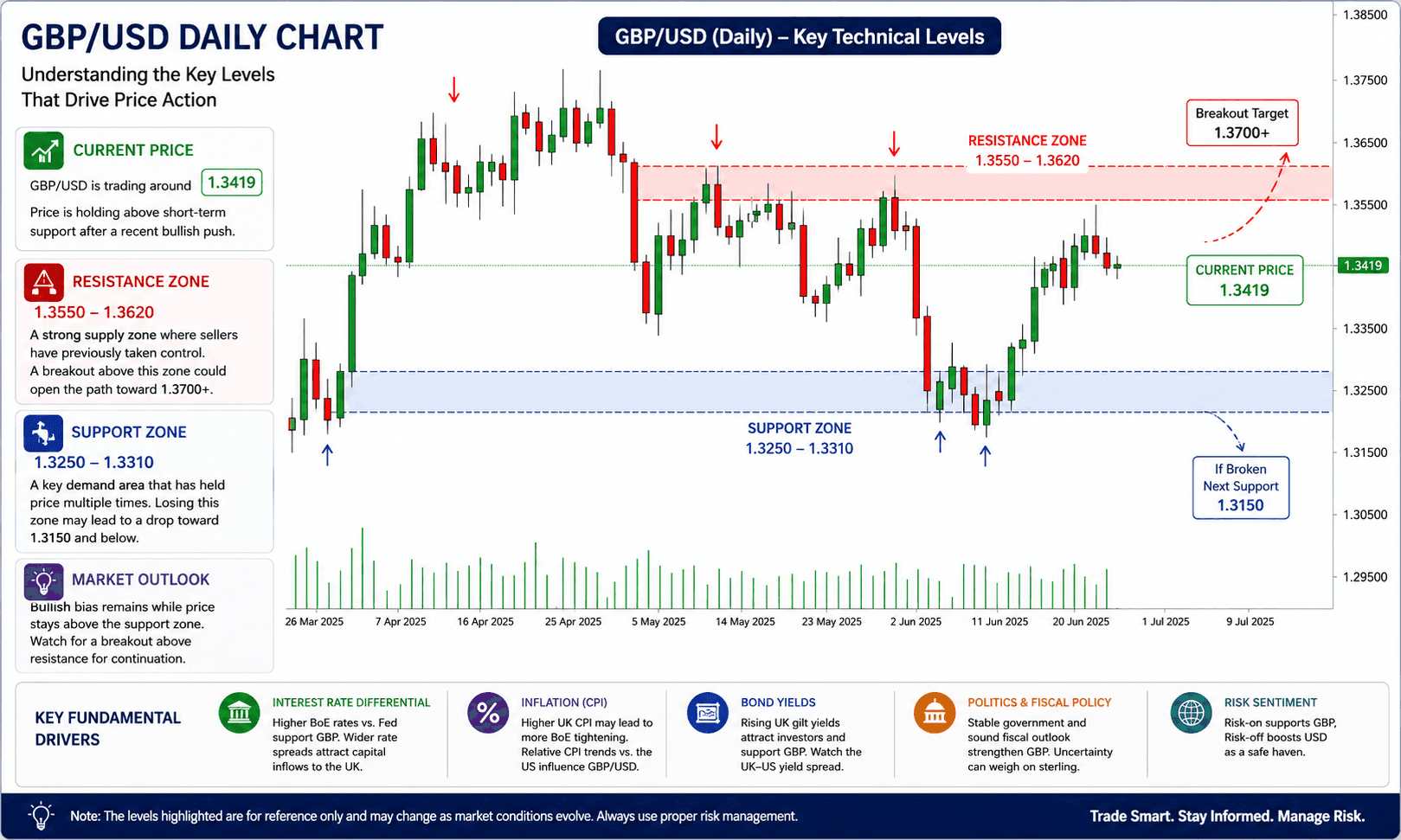
Featured banner as seen above is a snap of D1 chart of GBPUSD today, 13th of July, 2026. It highlights current GBPUSD price near 1.3419. As seen, the key support zone lies between 1.3250 and 1.3310; a decisive break below this area would expose the next downside objective around 1.3150. The principal resistance zone is 1.3550–1.3620, and a sustained breakout above it would open the way toward approximately 1.3700. The overall bias is cautiously bullish while price remains above the support zone, with traders watching for a confirmed break of resistance to signal a continuation of the advance.
And this is for scalpers: Trading GBPUSD around economic data releases is genuinely high-risk. A 5-pip stop-loss will not survive a CPI spike. Scalpers who survive long-term tend to avoid the 15 minutes either side of major data releases and focus instead on clean technical setups during calmer intraday windows. Position sizing matters here more than in any other approach; a single bad trade should not be capable of wiping out a week's scalping gains.
Risk Management When Trading GBPUSD
Why GBPUSD Volatility Demands a Disciplined Risk Management Approach
Cable's average daily range runs between 60 and 120 pips under normal conditions, and can exceed 200 pips on high-impact news days. A trader who deposits ₦160,000, selects 1:100 leverage, and opens a standard lot position has exposure of roughly $100,000 on a pair that regularly moves 100 pips in a session. A 100-pip adverse move at that position size costs approximately $1,000, which wipes the entire account. That scenario plays out for unprepared traders more often than it should.
Risk management is not optional on Cable. It is the difference between trading for months and blowing an account in an afternoon.
Setting Stop-Losses Around High-Impact Economic Events
Place your stop-loss before you open the trade. Not after. Deciding on your exit point while the market is moving against you is not a strategy; it is panic with extra steps.
For news events, stops need to account for the volatility that surrounds the release. A stop-loss placed 15 pips from entry ahead of a CPI release will almost certainly get hit regardless of which direction the market ultimately moves, because the initial spike often exceeds that range. Widen your stop to reflect realistic volatility expectations, then reduce your position size proportionally so that the total risk per trade remains within your pre-defined limit (typically 1-2% of account capital per trade, depending on your risk tolerance).
Position Sizing and Leverage: Protecting Your Capital on Cable Trades
Leverage amplifies both gains and losses. On Cable specifically, the right approach is to treat leverage as a tool for capital efficiency, not a mechanism for outsized returns. If your analysis is correct, appropriate position sizing will still generate meaningful returns. If your analysis is wrong, conservative sizing means you survive to trade another day.
A practical framework: decide the maximum monetary loss you are willing to accept on a single Cable trade, determine where your stop-loss should sit based on technical analysis, and then calculate the position size that makes those two numbers consistent. Most traders work backward from their target stop-loss in pips without adjusting position size, which means risk per trade varies wildly. It should be the other way around.
Building a Coherent Framework for Trading GBPUSD on Rally Trade
Combining Interest Rates, Bond Yields, CPI, and Political Signals
No single indicator drives Cable in isolation. The traders who consistently make sense of GBP/USD are the ones who build a hierarchy of signals and understand how they interact.
Start with the interest rate differential between the BoE and the Fed. That gives you the medium-term bias. Then check the gilt-Treasury yield spread to confirm whether bond markets agree with that assessment. Layer in the CPI trend from both countries to anticipate how the rate differential might shift. Finally, scan for political developments that could disrupt the expected path.
If all four layers point in the same direction, you have a strong fundamental conviction. If they conflict, caution is warranted, and position sizing should reflect that uncertainty.
Creating a Pre-Trade Checklist for Cable
Before entering any GBP/USD trade, run through these questions:
- What is the current BoE rate versus the Fed rate, and what does the market expect over the next 90 days?
- Is the gilt-Treasury yield spread widening or narrowing, and what is driving that move?
- When was the last UK and U.S. CPI release, and did it surprise to the upside or downside?
- Are there any major data releases or central bank communications scheduled in the next 24-48 hours that could sharply reprice Cable?
- What is the current risk sentiment environment: are equity markets calm or under stress?
- Where are the key technical support and resistance levels, and does my intended trade direction align with the fundamental bias?
A checklist like this takes three minutes. It will save you from the trades that, in hindsight, had obvious warning signs you chose to ignore.
Start Trading GBPUSD With Rally Trade Today
Rally Trade offers GBPUSD trading on MT5 trading platform, with competitive spreads during London and New York sessions. Naira-denominated deposits starting from ₦150,000 (equivalent to approximately $100) allow Nigerian traders to access Cable without navigating complex foreign currency transfers.
The Rally Trade copy trading platform also allows you to follow experienced traders who specialise in GBPUSD, giving you visibility into how professional participants approach the pair in real market conditions. That said, copy trading carries its own risks; the performance of any strategy provider can change, and past results do not guarantee future outcomes.
Cable rewards traders who take the time to understand what actually moves it. Interest rates, bond yields, CPI data, and political developments are not background noise. They are the signal.
Trading involves significant risk and is not suitable for all investors. Past performance does not indicate future results. Only commit capital you can afford to lose, and ensure you have a thorough understanding of how leveraged products work before opening positions on volatile pairs like GBP/USD.
Frequently Asked Questions
What is Cable in forex trading?
×
Cable is the nickname for the GBP/USD currency pair, one of the most actively traded pairs in the global forex market. The term dates back to the 19th century when exchange rates between the British pound and the U.S. dollar were transmitted via transatlantic telegraph cable. Today, Cable accounts for roughly 9.5% of all daily forex transactions, offering traders high liquidity and tight spreads.