Pin Bar Candlestick: How to Trade the Rejection Setup
Learn to trade the pin bar candlestick — the rejection setup price action traders trust. Spot bullish vs bearish pins, find high-probability zones, and place smart stops. Includes examples and common mistakes.

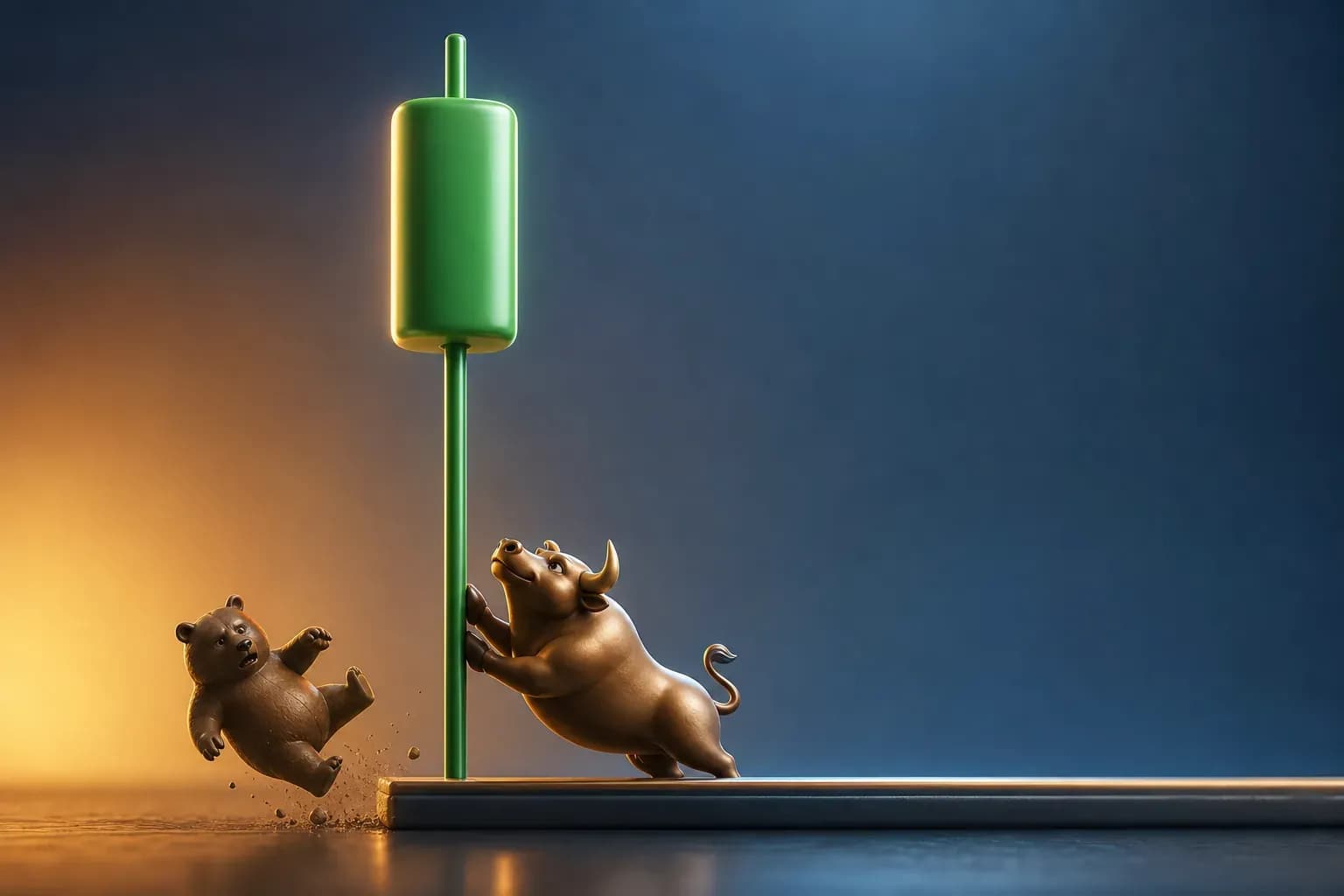
Why the Pin Bar Candlestick Is Every Price Action Trader's Favourite Signal
Ask ten price action traders which single candlestick they trust most, and a good number will point to the same one: the pin bar candlestick. Some traders like to call it "Hammer" because of it's symbolic long tail and a small head, like that of a hammer. It's simple to spot, it tells a clear story, and it shows up on every market you can name, from EUR/USD to Bitcoin to Gold.
The appeal is the honesty of it. A pin bar shows you a moment where price tried to go somewhere, got rejected, and snapped back. That single candle captures a fight between buyers and sellers, and it tells you who won. For traders who prefer reading raw charts over stacking a dozen indicators, this is the bread and butter of price action trading.
But a pin bar is only as good as the place you find it. Trade one in the wrong spot and you're just guessing with extra confidence. This guide covers what the signal means, how to read it, and how to trade rejections with sensible stops.
What Is a Pin Bar Candlestick?
A pin bar is a single candle with a long wick on one side, a small body, and little to no wick on the other. The word "pin" comes from "Pinocchio bar," because the long wick is the lie the market told: price pushed in one direction, then admitted it couldn't hold there and reversed.
That long wick is the whole point. It marks a level where the market was rejected.
The Meaning Behind the Rejection Candle
Picture GBP/USD climbing through a London session. Price spikes up, touches a level, then dumps back down before the candle closes. The result is a candle with a tall upper wick and a small body near the bottom. That is a rejection candle in its purest form: buyers pushed the price up, sellers overwhelmed them, and the close landed far below the high.
The longer the wick, the more violent the rejection. A wick that's four times the length of the body tells a stronger story than one that's barely double. You're reading the emotion of the market in one glance, which is why so many traders lean on it.
Where the Pin Bar Fits Among Candlestick Reversal Patterns
Candlestick reversal patterns come in families: engulfing candles, dojis, morning and evening stars, and single-candle signals like the pin bar. The pin bar sits in the single-candle group, which makes it faster to identify than multi-candle formations. You don't wait three candles to confirm anything.
The trade-off is that a single candle carries less weight than a confirmed multi-candle pattern. On its own, floating in the middle of nowhere, a pin bar means very little. Context does the heavy lifting, and we'll get to that.
Anatomy of a Pin Bar: The Long Wick Tells the Story
Three parts make up every pin bar, and each one carries information.
The Wick, the Body, and the Nose
The wick (also called the tail or shadow) is the long protrusion that shows the rejected price. The body is the coloured rectangle between the open and close, and on a valid pin bar it's small. The nose is the short wick on the opposite side of the body, ideally tiny or absent.

A clean pin bar has a wick that dwarfs the body, a body pushed to one end of the candle, and almost no nose. When you see all three at once, the signal is worth your attention.
What a Long Wick Reveals About Buyers and Sellers
A long lower wick means sellers drove price down during that period, then buyers stepped in hard enough to close it back near the top. The sellers lost the round. A long upper wick is the mirror image: buyers pushed up, sellers slammed it back, and the buyers lost.
This is the core insight of price action trading. You're not predicting the future; you're reading who currently holds the advantage at a specific price. The wick is the footprint of that battle.
What Makes a Valid Pin Bar (Rules of Thumb)
Not every candle with a wick qualifies. Traders generally look for a wick that's at least two-thirds of the candle's total length, with the body sitting at the far end. A wick two to three times the body length is a common minimum threshold.
Don't force it. If you're squinting at a candle trying to decide whether the wick is long enough, it probably isn't. The best pin bars are obvious. They jump off the chart without you having to measure anything.
Bullish Pin Bar vs Bearish Pin Bar
The direction of the wick tells you which way the rejection points. That's the entire distinction, and getting it wrong means trading the opposite of what the candle is telling you.
The Bullish Pin Bar: Rejection of Lower Prices
A bullish pin bar has a long lower wick and a small body near the top of the candle. It signals that price tested lower levels, got rejected, and buyers regained control. On USD/JPY sitting at a support zone, a bullish pin bar suggests buyers defended that level.
The candle's colour matters less than its shape. A bullish pin bar with a slightly red body is still bullish if the wick and body positions are right, though a green body adds a touch of confirmation.
The Bearish Pin Bar: Rejection of Higher Prices
A bearish pin bar flips it: long upper wick, small body near the bottom. Price tested higher, sellers took over, and the candle closed well below its high. Spot one of these forming at a resistance level after a rally and you're looking at a potential reversal signal.
How to Tell Them Apart at a Glance
Look at where the long wick points. Wick pointing down, body up top: bullish pin bar, rejection of lower prices. Wick pointing up, body at the bottom: bearish pin bar, rejection of higher prices.

The wick always points in the direction the market rejected. Your trade goes the opposite way of the wick.
The Best Places to Trade Pin Bars
Here's the truth most beginners skip: location beats the pattern every time. A textbook-perfect pin bar in a meaningless spot is worse than an average pin bar at a major level.
Pin Bars at Support and Resistance
Pin bars earn their reputation at support and resistance zones. When a bullish pin bar forms exactly at a support level that's held twice before, you have two pieces of evidence agreeing: a known level and a rejection candle confirming it. That confluence is what pin bar trading is built on.
Resistance works the same way in reverse. A bearish pin bar tapping a resistance ceiling gives you a high-quality setup because two independent signals point the same direction.
Pin Bars With the Trend
A trader watching an uptrend on EUR/USD sees price pull back to a rising support line, then prints a bullish pin bar. That's a trend-continuation setup: the pullback found a floor, and the trend is likely to resume. These often outperform counter-trend pin bars because you're trading with the dominant flow rather than against it.
Counter-trend pin bars can work, but they demand a stronger level and tighter risk. Fighting a strong trend on the strength of one candle is how accounts bleed.
When to Ignore a Pin Bar
Skip pin bars that form in the middle of a range with no level nearby. Skip them during dead, low-volume hours when spreads widen and price does strange things. And skip the marginal ones where you're not sure the wick is long enough.

A pin bar during the quiet gap between the New York close and the Tokyo open (roughly late evening WAT) often means nothing. Thin liquidity creates wicks that look like rejections but are just noise.
How to Trade a Pin Bar: Entry, Stop Loss, and Take Profit
Finding Your Entry Point
Two common entries exist. The aggressive entry gets you in at the market price the moment the pin bar closes. The conservative entry places a pending order at a 50% retracement of the pin bar's wick, giving you a better price if the market pulls back before running.
The 50% entry gets a tighter stop and better risk-reward, but you'll miss trades that never retrace. The market-on-close entry catches every setup but pays a worse price. Neither is objectively correct; pick one and stay consistent.
Placing a Sensible Stop Loss
Put your stop just beyond the tip of the pin bar's wick, plus a small buffer for spread. On a bullish pin bar, the stop goes below the low of the wick. On a bearish pin bar, it goes above the high.

The logic is clean: if price returns past the rejection point, the signal has failed and there's no reason to stay in. Don't move your stop closer to squeeze in a bigger position. That defeats the whole structure.
Setting a Realistic Take Profit
Target the next obvious level: a prior swing high, a resistance zone, a round number. Aim for a risk-reward of at least 1:2, meaning you risk one to make two. If your stop is 30 pips away, you want at least 60 pips of room to a sensible target.
Pin bars don't win every time. No pattern does. A 1:2 or better ratio means you can be right less than half the time and still come out ahead, which is exactly why the ratio matters more than the win rate.
A Worked Example and Common Mistakes to Avoid
Pin Bar Trade Example (Naira-Based Walkthrough)
A trader funds a Rally Trade account with ₦160,000 (roughly $100) and watches the daily chart on gold. Price falls to a support zone that held twice in the past month, then prints a clean bullish pin bar: long lower wick, small body up top, tiny nose.

She enters on the candle's close and sets her stop 20 pips below the wick's low. Her risk on the trade is kept to 1% of the account, about ₦1,600, so she sizes the position accordingly rather than maxing out leverage. Target: the previous swing high, sitting 45 pips away, giving better than 1:2 reward-to-risk.
If price hits the target, she makes roughly ₦3,600 on ₦1,600 risked. If it hits the stop, she loses the ₦1,600 and moves on. Either way, one trade never threatens the account. That discipline, not the candle itself, is what keeps traders in the game.
Mistakes That Trip Up New Pin Bar Traders
The biggest one: trading pin bars anywhere and everywhere. A pin bar without a level is just a candle. New traders also chase the wick, entering halfway through the candle before it closes, only to watch it morph into something else entirely. Wait for the close.

Oversizing is the silent killer. A perfect setup with 10% of your account on the line will hurt badly when it fails, and it will fail sometimes. Others ignore the trend completely, fading strong momentum on a single candle. And plenty of beginners move their stop into the wick to reduce risk, which just guarantees they get stopped out on normal price noise.
Start Practising Pin Bar Setups With Rally Trade
Reading about the pin bar candlestick gets you maybe a quarter of the way. The rest comes from screen time: spotting setups live, marking your levels, and testing entries without money on the line first. You can open a free demo account on MT5 platform to practise pin bar trading across forex, indices, and commodities before committing real capital.
When you're ready to go live, Naira deposits start from $100, and the in-person seminars run across Nigerian cities if you learn better with someone walking you through the charts. Start on demo, build a record of clean setups at real levels, and only then scale up.
Trading carries substantial risk and won't suit every investor. Past results tell you nothing guaranteed about future outcomes. Never commit money you can't afford to lose, and make sure you genuinely understand how leveraged products behave before you put capital at risk.
Frequently Asked Questions
What does a pin bar candlestick tell you?
×
A pin bar candlestick tells you that price tried to move in one direction, was rejected, and snapped back before the candle closed. The long wick marks the level where buyers or sellers were overwhelmed, signalling a potential reversal. On its own it means little, but at a key support or resistance level it becomes a strong price action signal.